›
›
›
›
Sales outsourcing for startups: what works in 2026
Sales outsourcing for startups: what works in 2026
Sales outsourcing for startups: what works in 2026
Sales outsourcing for startups: what works in 2026
Sales outsourcing for startups: what works in 2026
Sales outsourcing for startups: what works in 2026

Author
Aljaz Peklaj

Most startup founders are told to demand volume from an outsourced sales partner immediately. That advice is backwards. Sending 500 unvalidated emails in week one can produce an impressive activity report while damaging the list, the sending infrastructure, and the team's confidence before the sales motion has earned the right to scale.
The first 30 days should produce proof, not volume.
Each milestone should build on the last, from ICP validation to a controlled sequence and qualified meetings.
Raw meetings flatter vendors. Strictly qualified meetings reveal whether the machine works.
Agencies, RPO teams, and freelancers solve different problems, and the wrong model creates expensive ambiguity.
Speed-to-lead, reply routing, and downstream conversion matter more than send counts.
Table of Contents
Why most outsourced sales programs fail in month one
The most common failure starts with a reasonable startup expectation: outsource sales, then see revenue quickly. By week two, the founder asks for more activity. The vendor responds by increasing sends, often before anyone has validated the ICP, the data, or the message. Both sides then judge the program through output volume, even though the underlying system is still untested.
That sequence burns trust first, then assets. A weak list can't be recovered by adding more prospects, and a damaged sending setup won't improve because a dashboard shows more emails sent. The first month should answer a narrower question: can this team repeatedly identify the right account, create a relevant conversation, and hand over a meeting that deserves sales attention?
Practical rule: A partner bragging about week-one send volume is usually reporting activity, not pipeline.
The market context supports a more deliberate operating model. One estimate places the outsourced sales services market at USD 6.8 billion in 2025, with a projection to USD 12.1 billion by 2034, a 6.5% CAGR, while a separate analysis places the global sales and marketing BPO segment at USD 30.70 billion in 2023 and projects USD 57.46 billion by 2030. These figures show that outsourcing is an established commercial category, not a temporary staffing workaround, but they don't prove that any individual vendor can qualify your buyers. The market estimate is useful context, not a substitute for operating discipline.
What week one should prove
Week one success has three visible outputs:
ICP lock: The team reverse-engineers closed-won and lost deals, then records the shared traits of the accounts worth pursuing.
Deliverability readiness: Sending domains, inboxes, and warmup are in progress before meaningful volume begins.
Message ownership: The founder and delivery team agree on the problem, trigger, and qualification bar.
The ICP shouldn't read like “SaaS companies with 50 to 250 employees.” It should combine buying context, role, trigger, and displacement opportunity, such as a company that has just hired its first RevOps leader and is using a competitor that can be replaced.
Teams comparing internal hiring with outsourcing can also review proven shortlists from GENTY recruitment to understand the staffing alternative. That comparison matters because an agency isn't automatically the right answer. The decision depends on whether the startup needs a managed system, extra capacity, or one narrow task.
The gate logic
The first milestone validates the audience. The second tests the message against a controlled cohort. The third checks whether replies become qualified conversations. Skipping a gate means scaling a mistake.
That principle also shapes how GROU frames outsourced lead generation. Lead sourcing, enrichment, outbound, and routing need one reporting line. If each function has a separate owner and a separate definition of success, the startup gets disconnected activity instead of a usable pipeline signal.
Choosing between agency, RPO, and freelancer models
Agencies are the right choice when a startup needs the sales infrastructure built and operated. RPO fits a company that already has a sales process and needs capacity. Freelancers work only for narrow tasks, such as list research or copy support. Treating the three models as interchangeable is how accountability disappears.
An agency can own targeting, enrichment, sequencing, CRM routing, reporting, and iteration. That makes it the strongest fit for an early B2B company entering a new segment, particularly across SaaS, iGaming, manufacturing, legal tech, or pharma where the message and buying committee need active refinement. The trade-off is cost and dependency at scale. Once the motion needs daily internal judgment, an agency may become less efficient than an embedded hire.
RPO is different. It adds people inside an existing operating model, so the startup must already have clear definitions, managers, tooling, and handoff rules. If those pieces aren't in place, the RPO team adds capacity to a process that is already unclear.
A freelancer can be effective for a bounded assignment. Give one person a clean account list, a defined research field, or a specific sequence audit. Don't expect that person to own deliverability, CRM hygiene, qualification, channel coordination, and revenue attribution at the same time.

Outsourcing model comparison
Model | Typical cost | Time to first qualified meeting | Best fit |
|---|---|---|---|
Agency | Depends on scope and infrastructure ownership | After ICP, data, and message validation | Startups needing a managed pipeline system |
RPO | Depends on team size and internal management | After internal process onboarding | Companies with an operating sales function needing capacity |
Freelancer | Task-specific and scope-dependent | After the assigned task is complete | List building, research, or copy work with clear ownership |
The table intentionally avoids invented price ranges and promises. Cost and timing change with deal size, market, data quality, channel mix, and whether the provider owns the operating layer. A founder evaluating funding runway can use the NowFunded blog on startup funding for broader financial planning, but the outsourcing decision still belongs in a sales operating model, not a generic budget line.
The agency model wins for most startups that lack RevOps coverage, because one accountable partner can connect prospect selection to qualified handoff. That doesn't mean signing an open-ended contract. Keep the infrastructure and data in company-controlled accounts, define cancellation terms, and require CRM visibility from the first cohort.
A useful guide to outsourcing a sales company should answer who owns each step, what happens when a meeting is rejected, and how the provider proves downstream quality. If the answer is only “our SDRs send outreach,” the model is too narrow for a startup buying pipeline rather than temporary labor.
The 30-day sprint roadmap with three proof milestones
The first 30 days should run as a controlled build. Infrastructure setup happens alongside research, but volume remains gated. The roadmap has three milestones, and each one creates the evidence required for the next.
Milestone one by the end of week one
Start with closed-won reverse-engineering and ICP lock. Pull the startup's existing wins, even if there are only 5 to 10, then examine lost deals for contrast. Look for buying role, company situation, trigger, incumbent product, urgency, and the reason the deal advanced.
The output is a compound criterion, not a broad industry label. A useful profile might combine funding stage, a newly hired RevOps leader, an active operational trigger, and use of a competitor that the startup can displace.
Sending domains, inboxes, and warmup begin in parallel. The operating ceiling for bounces should be 3%, ideally near 1%, because list quality is part of pipeline quality. A vendor that delays infrastructure until after copy approval is already treating deliverability as an afterthought.
Milestone two by the end of week two
Build the first list against the locked criteria and enrich it through a waterfall process. Clay can combine multiple enrichment sources, while Apollo or Sales Navigator can support account discovery. The target is 85% to 90% coverage for the first dataset, cited in the 30-day sprint methodology, but coverage alone doesn't make a contact qualified.
Launch a 5-touch sequence to a deliberately small cohort. Lemlist, Instantly, or Smartlead can handle email execution. HeyReach can support LinkedIn steps, while HubSpot should capture source, trigger, reply type, qualification status, and next action.
Sending to the entire audience in week two is a preventable error. A controlled cohort gives the team signal on the opener, trigger, segment, and objection before the list is exhausted. The gate is simple: don't scale the audience until the message has earned more testing.
Milestone three by the end of week four
The standard is the first qualified meeting inside 30 days, not a calendar filled with anyone willing to talk. By the end of the month, the team should have reply data, reviewed conversations, and a closed feedback loop between the provider and the startup's sales owner.
Review which opener generated replies, which trigger attracted the right accounts, and which segment produced genuine pain. Then adjust the sequence before increasing volume in month two.
Email remains only one part of the system. LinkedIn engagement, reply routing, qualification notes, and a clear owner inside the CRM determine whether a response becomes a sales conversation. Resources such as EmailScout's guidance on building a sales pipeline are useful for thinking about the handoff, but the startup still needs its own qualification rules.
The sequencing logic is the point. Validate the list before testing copy, prove the copy before increasing volume, and confirm the handoff before calling the program scalable. Slow is smooth, and smooth is fast.
The four conversion thresholds that reveal pipeline quality
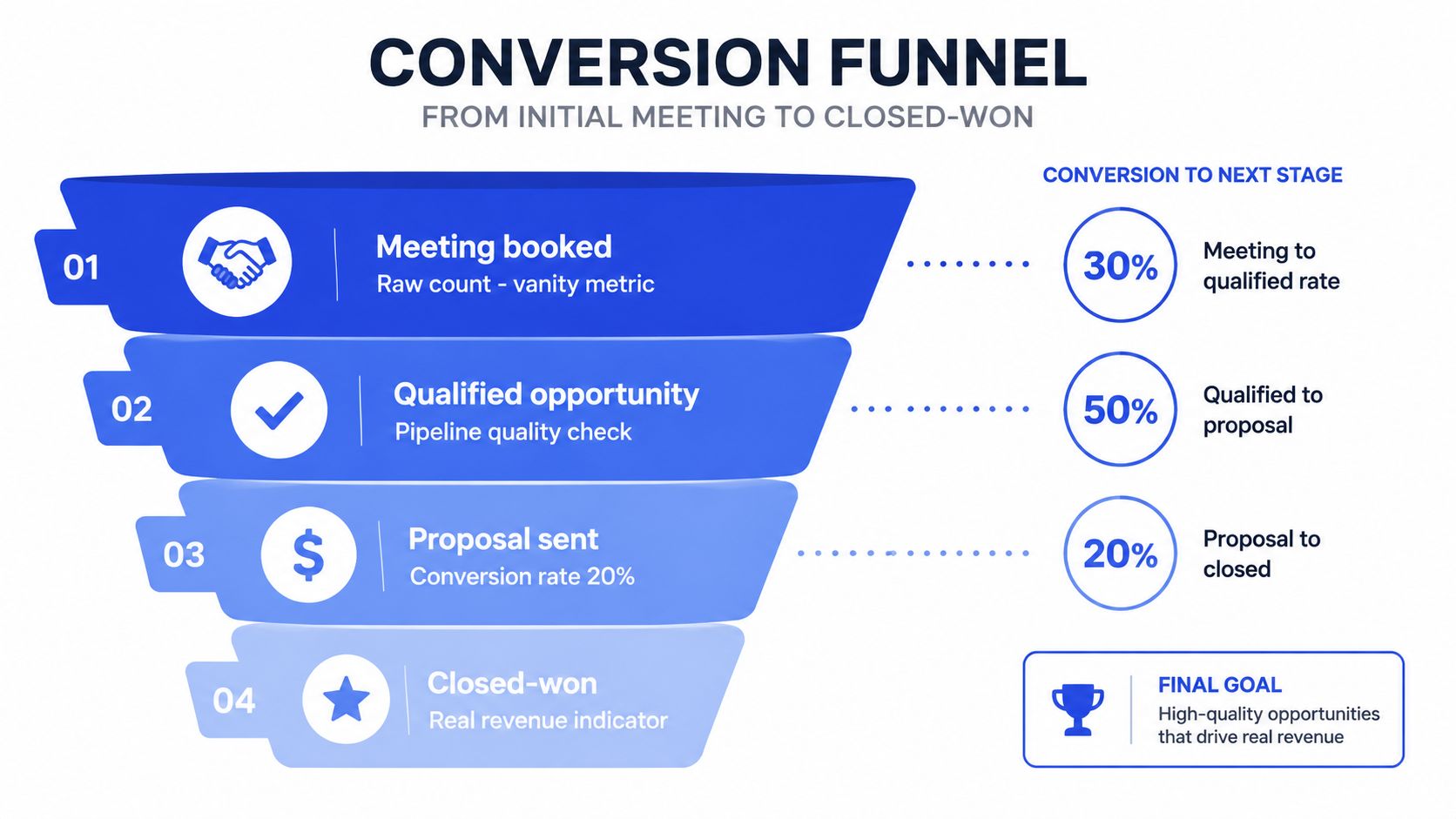
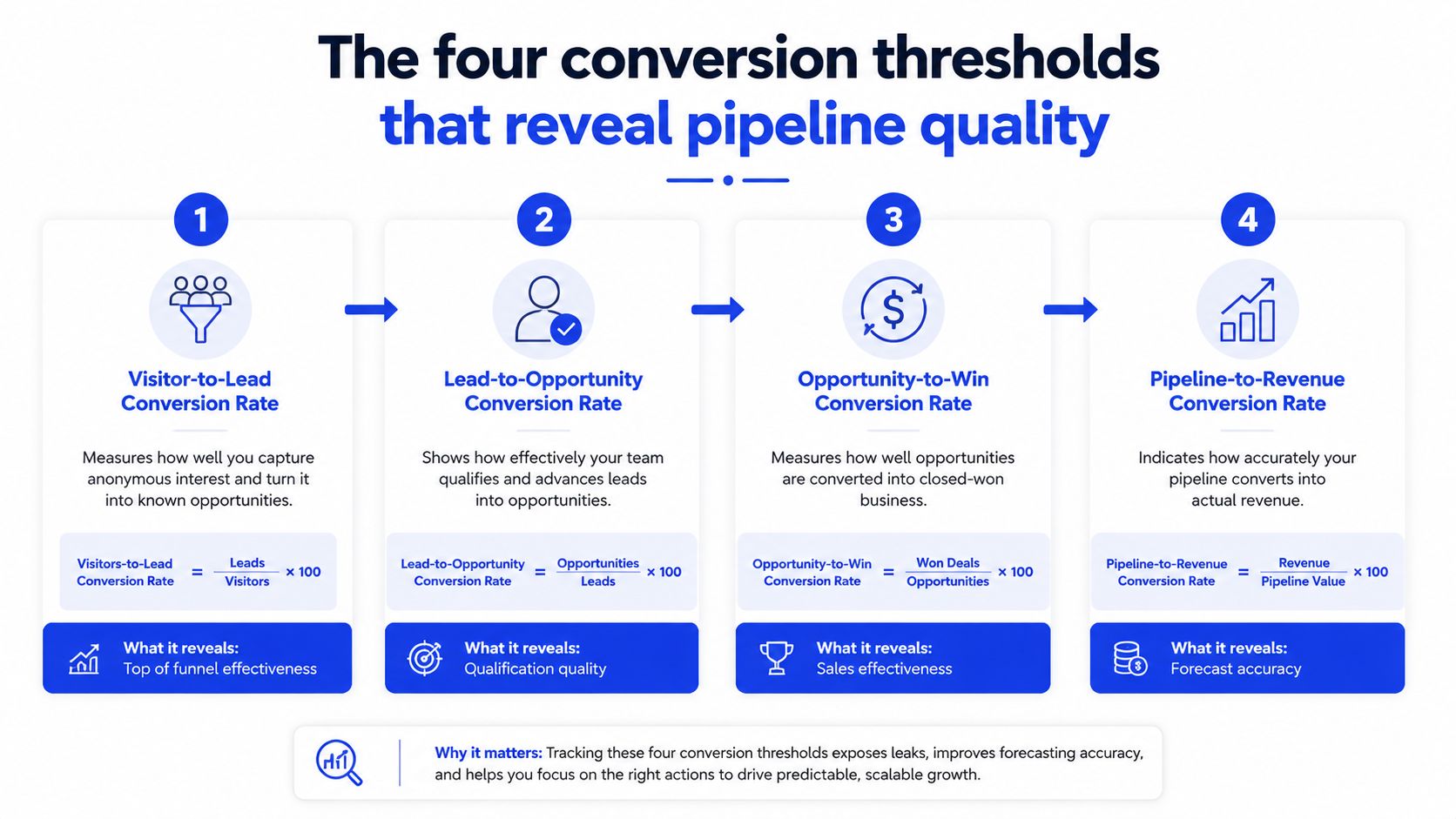
Vendors can inflate activity without creating useful opportunities. The protection is to monitor the funnel in order, starting with the first signal and ending with revenue. The four thresholds are reply rate, held-meeting rate, meeting-to-opportunity rate, and opportunity-to-won rate.
Reply rate tells you whether targeting and message relevance are working. It doesn't tell you whether the respondent fits the ICP. Held-meeting rate shows whether the prospect had enough intent to attend, and whether the booking process, reminders, and calendar ownership are functioning.
Meeting-to-opportunity conversion is where many outsourced programs become uncomfortable. A meeting can be held by the right title and still lack pain, authority, timing, or a credible next step. If this threshold is weak, increasing sends usually makes the reporting look busier while making the sales team less productive.
A qualified meeting should survive contact with the account executive's calendar.
The benchmark range
Benchmark data for fully ramped outsourced SDR programs reports 8 to 14 qualified meetings per month, 30% to 50% held-meeting-to-opportunity conversion, and 15% to 25% opportunity-to-won conversion. The same source warns that only 7% of companies report outsourced SDRs have worked. These figures come from outsourced SDR benchmarks, and they should be treated as directional operating references, not promises.
Another benchmark reports an 18% to 24% SQL rate of all meetings booked for outsourced lead-generation programs using ICP targeting, intent enrichment, multi-touch outreach, and qualification gates. That source is the lead-generation outsourcing benchmark. The practical lesson is that meeting volume belongs below conversion quality in the reporting hierarchy.
The manager should inspect the sequence like this:
Reply rate: Are the right accounts responding to a relevant trigger?
Held-meeting rate: Do booked prospects attend and understand why they accepted?
Meeting-to-opportunity rate: Does the conversation produce acknowledged pain and a real sales path?
Opportunity-to-won rate: Does the opportunity survive pricing, competition, procurement, and internal review?
A weak downstream number is usually a qualification, ICP, or handoff problem. It isn't automatically a top-of-funnel problem. Use sales pipeline management to keep stage definitions and ownership visible, then review the conversion path rather than rewarding the highest activity count.
Speed matters inside this framework. A 2024 benchmark testing 1,000 B2B companies found that only 365 replied to an inbound demo request, while the average response time among responders was 1 day, 5 hours, and 17 minutes. It also reported that 63.5% never responded, according to RevenueHero's lead response research. A startup should therefore specify ownership and routing in the brief, rather than assuming the vendor will follow up quickly.
The five-minute threshold remains central. Companies responding within 5 minutes are reported as about 100 times more likely to make contact and 21 times more likely to qualify a lead than companies waiting 30 minutes, based on recent lead-response research summaries. The exact mechanics should be tested in the startup's CRM, but the operating position is clear: a next-day response is not a speed-to-lead system.
Setting qualification bars that prevent vendor gaming
Define “qualified” before the first campaign launches. The vendor shouldn't get to rewrite the definition after seeing the numbers.
A qualified meeting must clear four conditions:
Right ICP: The account fits the agreed company, market, use-case, and trigger criteria.
Right seniority: The attendee can influence the problem or bring the decision forward.
Real acknowledged pain: The prospect has confirmed a problem the offer addresses.
Genuine next step: Both sides agree on a concrete follow-up, not a polite “send me something.”
If one condition fails, the meeting can remain a conversation, but it shouldn't count toward the qualified-meeting KPI. A loose SQL definition lets a provider hit its target while the sales team inherits tourists.
Pipeline value is useful later, once opportunities have aged through the sales cycle. In month one, it is too early and too easy to inflate with optimistic deal sizing. Raw meetings have the opposite weakness, they are immediate but easy to manufacture. Qualified meetings against a strict, client-agreed bar are the earliest useful signal that the machine works.
The month-one standard should be explicit: the first qualified meeting inside 30 days, with several qualified meetings by month end for a healthy startup motion. Don't turn that into a universal meeting quota. A startup selling a €5k SaaS tool to SMBs and a startup selling a €150k enterprise platform operate under different market conditions, so raw counts aren't comparable.
Use a shared qualification field in HubSpot, Salesforce, or the system where the provider records activity. Require the reason for qualification, the trigger, the stated pain, the attendee's role, and the next step. Then review rejected meetings in the weekly operating call.
Accountability test: If the vendor can't show why a meeting qualified, it shouldn't receive credit for the meeting.
The lead qualification process should also define rejection handling. Sales representatives need permission to reject poor-fit meetings without creating a political fight, and the provider needs a feedback reason it can apply to the next cohort.
That feedback loop protects both sides. The startup gets an honest view of pipeline quality, while the vendor gets a usable signal for targeting and copy. A provider that resists the bar is telling you that its economics depend on counting activity rather than producing sales-ready conversations.
Bridging the culture gap between startup speed and outbound deliberation
The first fortnight exposes a tempo problem. Startups are trained to move quickly, while outbound teams need to move carefully enough to avoid scaling a bad assumption. When the founder demands more sends, the vendor may comply to protect the relationship, and the program starts consuming domains and prospects before the message has been tested.
Founder-led companies face a second problem. The founder was often the strongest salesperson, so handing the message to an external team can feel like surrendering control over the company's story. Reassurance won't fix that. Visibility will.
The week-one operating agreement
Put the definition of early success in writing:
Week one: ICP lock, deliverability setup, and message co-creation.
Week two: Enriched list, controlled cohort, and early reply review.
Week four: First qualified meeting and a documented feedback loop.
Install a weekly 30-minute operations sync with the founder, sales owner, and provider. Use the meeting to review account samples, reply categories, rejected contacts, sequence changes, and the next gate. A shared Slack channel can handle daily questions without turning every decision into an emergency meeting.
The founder should co-write the first sequence with the delivery team. Reverse-engineer winning deals in the room, agree on the trigger language, and review the first contacts before launch. That process keeps the founder's market knowledge in the system while giving the outsourced team clear authority to execute.
The sales and marketing alignment framework matters here because marketing often owns positioning while sales owns qualification. If those teams disagree about the buyer or the promise, an outsourced provider receives conflicting instructions and reports activity against an unstable message.
Set the proof expectation clearly: first qualified meeting inside 30 days. That gives the founder a near-term test without pressuring the vendor to manufacture volume. Tempo and trust improve when everyone can see which gate is open, which gate is blocked, and what evidence is required to proceed.
Grou offers a managed B2B pipeline system that connects ICP research, email and LinkedIn outreach, reply routing, and strict qualification rules for startups and revenue teams. Visit Grou to review the approach, then audit your last ten sequences against the four conversion thresholds before booking a discovery call.
Grou is trusted by 50+ companies across iGaming, SaaS, manufacturing, and professional services. Its methodology uses bi-weekly sprints, shared reporting, enriched ICP-aligned lists, and a first-signal target inside 30 days.
Most startup founders are told to demand volume from an outsourced sales partner immediately. That advice is backwards. Sending 500 unvalidated emails in week one can produce an impressive activity report while damaging the list, the sending infrastructure, and the team's confidence before the sales motion has earned the right to scale.
The first 30 days should produce proof, not volume.
Each milestone should build on the last, from ICP validation to a controlled sequence and qualified meetings.
Raw meetings flatter vendors. Strictly qualified meetings reveal whether the machine works.
Agencies, RPO teams, and freelancers solve different problems, and the wrong model creates expensive ambiguity.
Speed-to-lead, reply routing, and downstream conversion matter more than send counts.
Table of Contents
Why most outsourced sales programs fail in month one
The most common failure starts with a reasonable startup expectation: outsource sales, then see revenue quickly. By week two, the founder asks for more activity. The vendor responds by increasing sends, often before anyone has validated the ICP, the data, or the message. Both sides then judge the program through output volume, even though the underlying system is still untested.
That sequence burns trust first, then assets. A weak list can't be recovered by adding more prospects, and a damaged sending setup won't improve because a dashboard shows more emails sent. The first month should answer a narrower question: can this team repeatedly identify the right account, create a relevant conversation, and hand over a meeting that deserves sales attention?
Practical rule: A partner bragging about week-one send volume is usually reporting activity, not pipeline.
The market context supports a more deliberate operating model. One estimate places the outsourced sales services market at USD 6.8 billion in 2025, with a projection to USD 12.1 billion by 2034, a 6.5% CAGR, while a separate analysis places the global sales and marketing BPO segment at USD 30.70 billion in 2023 and projects USD 57.46 billion by 2030. These figures show that outsourcing is an established commercial category, not a temporary staffing workaround, but they don't prove that any individual vendor can qualify your buyers. The market estimate is useful context, not a substitute for operating discipline.
What week one should prove
Week one success has three visible outputs:
ICP lock: The team reverse-engineers closed-won and lost deals, then records the shared traits of the accounts worth pursuing.
Deliverability readiness: Sending domains, inboxes, and warmup are in progress before meaningful volume begins.
Message ownership: The founder and delivery team agree on the problem, trigger, and qualification bar.
The ICP shouldn't read like “SaaS companies with 50 to 250 employees.” It should combine buying context, role, trigger, and displacement opportunity, such as a company that has just hired its first RevOps leader and is using a competitor that can be replaced.
Teams comparing internal hiring with outsourcing can also review proven shortlists from GENTY recruitment to understand the staffing alternative. That comparison matters because an agency isn't automatically the right answer. The decision depends on whether the startup needs a managed system, extra capacity, or one narrow task.
The gate logic
The first milestone validates the audience. The second tests the message against a controlled cohort. The third checks whether replies become qualified conversations. Skipping a gate means scaling a mistake.
That principle also shapes how GROU frames outsourced lead generation. Lead sourcing, enrichment, outbound, and routing need one reporting line. If each function has a separate owner and a separate definition of success, the startup gets disconnected activity instead of a usable pipeline signal.
Choosing between agency, RPO, and freelancer models
Agencies are the right choice when a startup needs the sales infrastructure built and operated. RPO fits a company that already has a sales process and needs capacity. Freelancers work only for narrow tasks, such as list research or copy support. Treating the three models as interchangeable is how accountability disappears.
An agency can own targeting, enrichment, sequencing, CRM routing, reporting, and iteration. That makes it the strongest fit for an early B2B company entering a new segment, particularly across SaaS, iGaming, manufacturing, legal tech, or pharma where the message and buying committee need active refinement. The trade-off is cost and dependency at scale. Once the motion needs daily internal judgment, an agency may become less efficient than an embedded hire.
RPO is different. It adds people inside an existing operating model, so the startup must already have clear definitions, managers, tooling, and handoff rules. If those pieces aren't in place, the RPO team adds capacity to a process that is already unclear.
A freelancer can be effective for a bounded assignment. Give one person a clean account list, a defined research field, or a specific sequence audit. Don't expect that person to own deliverability, CRM hygiene, qualification, channel coordination, and revenue attribution at the same time.
Outsourcing model comparison
Model | Typical cost | Time to first qualified meeting | Best fit |
|---|---|---|---|
Agency | Depends on scope and infrastructure ownership | After ICP, data, and message validation | Startups needing a managed pipeline system |
RPO | Depends on team size and internal management | After internal process onboarding | Companies with an operating sales function needing capacity |
Freelancer | Task-specific and scope-dependent | After the assigned task is complete | List building, research, or copy work with clear ownership |
The table intentionally avoids invented price ranges and promises. Cost and timing change with deal size, market, data quality, channel mix, and whether the provider owns the operating layer. A founder evaluating funding runway can use the NowFunded blog on startup funding for broader financial planning, but the outsourcing decision still belongs in a sales operating model, not a generic budget line.
The agency model wins for most startups that lack RevOps coverage, because one accountable partner can connect prospect selection to qualified handoff. That doesn't mean signing an open-ended contract. Keep the infrastructure and data in company-controlled accounts, define cancellation terms, and require CRM visibility from the first cohort.
A useful guide to outsourcing a sales company should answer who owns each step, what happens when a meeting is rejected, and how the provider proves downstream quality. If the answer is only “our SDRs send outreach,” the model is too narrow for a startup buying pipeline rather than temporary labor.
The 30-day sprint roadmap with three proof milestones
The first 30 days should run as a controlled build. Infrastructure setup happens alongside research, but volume remains gated. The roadmap has three milestones, and each one creates the evidence required for the next.
Milestone one by the end of week one
Start with closed-won reverse-engineering and ICP lock. Pull the startup's existing wins, even if there are only 5 to 10, then examine lost deals for contrast. Look for buying role, company situation, trigger, incumbent product, urgency, and the reason the deal advanced.
The output is a compound criterion, not a broad industry label. A useful profile might combine funding stage, a newly hired RevOps leader, an active operational trigger, and use of a competitor that the startup can displace.
Sending domains, inboxes, and warmup begin in parallel. The operating ceiling for bounces should be 3%, ideally near 1%, because list quality is part of pipeline quality. A vendor that delays infrastructure until after copy approval is already treating deliverability as an afterthought.
Milestone two by the end of week two
Build the first list against the locked criteria and enrich it through a waterfall process. Clay can combine multiple enrichment sources, while Apollo or Sales Navigator can support account discovery. The target is 85% to 90% coverage for the first dataset, cited in the 30-day sprint methodology, but coverage alone doesn't make a contact qualified.
Launch a 5-touch sequence to a deliberately small cohort. Lemlist, Instantly, or Smartlead can handle email execution. HeyReach can support LinkedIn steps, while HubSpot should capture source, trigger, reply type, qualification status, and next action.
Sending to the entire audience in week two is a preventable error. A controlled cohort gives the team signal on the opener, trigger, segment, and objection before the list is exhausted. The gate is simple: don't scale the audience until the message has earned more testing.
Milestone three by the end of week four
The standard is the first qualified meeting inside 30 days, not a calendar filled with anyone willing to talk. By the end of the month, the team should have reply data, reviewed conversations, and a closed feedback loop between the provider and the startup's sales owner.
Review which opener generated replies, which trigger attracted the right accounts, and which segment produced genuine pain. Then adjust the sequence before increasing volume in month two.
Email remains only one part of the system. LinkedIn engagement, reply routing, qualification notes, and a clear owner inside the CRM determine whether a response becomes a sales conversation. Resources such as EmailScout's guidance on building a sales pipeline are useful for thinking about the handoff, but the startup still needs its own qualification rules.
The sequencing logic is the point. Validate the list before testing copy, prove the copy before increasing volume, and confirm the handoff before calling the program scalable. Slow is smooth, and smooth is fast.
The four conversion thresholds that reveal pipeline quality
Vendors can inflate activity without creating useful opportunities. The protection is to monitor the funnel in order, starting with the first signal and ending with revenue. The four thresholds are reply rate, held-meeting rate, meeting-to-opportunity rate, and opportunity-to-won rate.
Reply rate tells you whether targeting and message relevance are working. It doesn't tell you whether the respondent fits the ICP. Held-meeting rate shows whether the prospect had enough intent to attend, and whether the booking process, reminders, and calendar ownership are functioning.
Meeting-to-opportunity conversion is where many outsourced programs become uncomfortable. A meeting can be held by the right title and still lack pain, authority, timing, or a credible next step. If this threshold is weak, increasing sends usually makes the reporting look busier while making the sales team less productive.
A qualified meeting should survive contact with the account executive's calendar.
The benchmark range
Benchmark data for fully ramped outsourced SDR programs reports 8 to 14 qualified meetings per month, 30% to 50% held-meeting-to-opportunity conversion, and 15% to 25% opportunity-to-won conversion. The same source warns that only 7% of companies report outsourced SDRs have worked. These figures come from outsourced SDR benchmarks, and they should be treated as directional operating references, not promises.
Another benchmark reports an 18% to 24% SQL rate of all meetings booked for outsourced lead-generation programs using ICP targeting, intent enrichment, multi-touch outreach, and qualification gates. That source is the lead-generation outsourcing benchmark. The practical lesson is that meeting volume belongs below conversion quality in the reporting hierarchy.
The manager should inspect the sequence like this:
Reply rate: Are the right accounts responding to a relevant trigger?
Held-meeting rate: Do booked prospects attend and understand why they accepted?
Meeting-to-opportunity rate: Does the conversation produce acknowledged pain and a real sales path?
Opportunity-to-won rate: Does the opportunity survive pricing, competition, procurement, and internal review?
A weak downstream number is usually a qualification, ICP, or handoff problem. It isn't automatically a top-of-funnel problem. Use sales pipeline management to keep stage definitions and ownership visible, then review the conversion path rather than rewarding the highest activity count.
Speed matters inside this framework. A 2024 benchmark testing 1,000 B2B companies found that only 365 replied to an inbound demo request, while the average response time among responders was 1 day, 5 hours, and 17 minutes. It also reported that 63.5% never responded, according to RevenueHero's lead response research. A startup should therefore specify ownership and routing in the brief, rather than assuming the vendor will follow up quickly.
The five-minute threshold remains central. Companies responding within 5 minutes are reported as about 100 times more likely to make contact and 21 times more likely to qualify a lead than companies waiting 30 minutes, based on recent lead-response research summaries. The exact mechanics should be tested in the startup's CRM, but the operating position is clear: a next-day response is not a speed-to-lead system.
Setting qualification bars that prevent vendor gaming
Define “qualified” before the first campaign launches. The vendor shouldn't get to rewrite the definition after seeing the numbers.
A qualified meeting must clear four conditions:
Right ICP: The account fits the agreed company, market, use-case, and trigger criteria.
Right seniority: The attendee can influence the problem or bring the decision forward.
Real acknowledged pain: The prospect has confirmed a problem the offer addresses.
Genuine next step: Both sides agree on a concrete follow-up, not a polite “send me something.”
If one condition fails, the meeting can remain a conversation, but it shouldn't count toward the qualified-meeting KPI. A loose SQL definition lets a provider hit its target while the sales team inherits tourists.
Pipeline value is useful later, once opportunities have aged through the sales cycle. In month one, it is too early and too easy to inflate with optimistic deal sizing. Raw meetings have the opposite weakness, they are immediate but easy to manufacture. Qualified meetings against a strict, client-agreed bar are the earliest useful signal that the machine works.
The month-one standard should be explicit: the first qualified meeting inside 30 days, with several qualified meetings by month end for a healthy startup motion. Don't turn that into a universal meeting quota. A startup selling a €5k SaaS tool to SMBs and a startup selling a €150k enterprise platform operate under different market conditions, so raw counts aren't comparable.
Use a shared qualification field in HubSpot, Salesforce, or the system where the provider records activity. Require the reason for qualification, the trigger, the stated pain, the attendee's role, and the next step. Then review rejected meetings in the weekly operating call.
Accountability test: If the vendor can't show why a meeting qualified, it shouldn't receive credit for the meeting.
The lead qualification process should also define rejection handling. Sales representatives need permission to reject poor-fit meetings without creating a political fight, and the provider needs a feedback reason it can apply to the next cohort.
That feedback loop protects both sides. The startup gets an honest view of pipeline quality, while the vendor gets a usable signal for targeting and copy. A provider that resists the bar is telling you that its economics depend on counting activity rather than producing sales-ready conversations.
Bridging the culture gap between startup speed and outbound deliberation
The first fortnight exposes a tempo problem. Startups are trained to move quickly, while outbound teams need to move carefully enough to avoid scaling a bad assumption. When the founder demands more sends, the vendor may comply to protect the relationship, and the program starts consuming domains and prospects before the message has been tested.
Founder-led companies face a second problem. The founder was often the strongest salesperson, so handing the message to an external team can feel like surrendering control over the company's story. Reassurance won't fix that. Visibility will.
The week-one operating agreement
Put the definition of early success in writing:
Week one: ICP lock, deliverability setup, and message co-creation.
Week two: Enriched list, controlled cohort, and early reply review.
Week four: First qualified meeting and a documented feedback loop.
Install a weekly 30-minute operations sync with the founder, sales owner, and provider. Use the meeting to review account samples, reply categories, rejected contacts, sequence changes, and the next gate. A shared Slack channel can handle daily questions without turning every decision into an emergency meeting.
The founder should co-write the first sequence with the delivery team. Reverse-engineer winning deals in the room, agree on the trigger language, and review the first contacts before launch. That process keeps the founder's market knowledge in the system while giving the outsourced team clear authority to execute.
The sales and marketing alignment framework matters here because marketing often owns positioning while sales owns qualification. If those teams disagree about the buyer or the promise, an outsourced provider receives conflicting instructions and reports activity against an unstable message.
Set the proof expectation clearly: first qualified meeting inside 30 days. That gives the founder a near-term test without pressuring the vendor to manufacture volume. Tempo and trust improve when everyone can see which gate is open, which gate is blocked, and what evidence is required to proceed.
Grou offers a managed B2B pipeline system that connects ICP research, email and LinkedIn outreach, reply routing, and strict qualification rules for startups and revenue teams. Visit Grou to review the approach, then audit your last ten sequences against the four conversion thresholds before booking a discovery call.
Grou is trusted by 50+ companies across iGaming, SaaS, manufacturing, and professional services. Its methodology uses bi-weekly sprints, shared reporting, enriched ICP-aligned lists, and a first-signal target inside 30 days.
Most startup founders are told to demand volume from an outsourced sales partner immediately. That advice is backwards. Sending 500 unvalidated emails in week one can produce an impressive activity report while damaging the list, the sending infrastructure, and the team's confidence before the sales motion has earned the right to scale.
The first 30 days should produce proof, not volume.
Each milestone should build on the last, from ICP validation to a controlled sequence and qualified meetings.
Raw meetings flatter vendors. Strictly qualified meetings reveal whether the machine works.
Agencies, RPO teams, and freelancers solve different problems, and the wrong model creates expensive ambiguity.
Speed-to-lead, reply routing, and downstream conversion matter more than send counts.
Table of Contents
Why most outsourced sales programs fail in month one
The most common failure starts with a reasonable startup expectation: outsource sales, then see revenue quickly. By week two, the founder asks for more activity. The vendor responds by increasing sends, often before anyone has validated the ICP, the data, or the message. Both sides then judge the program through output volume, even though the underlying system is still untested.
That sequence burns trust first, then assets. A weak list can't be recovered by adding more prospects, and a damaged sending setup won't improve because a dashboard shows more emails sent. The first month should answer a narrower question: can this team repeatedly identify the right account, create a relevant conversation, and hand over a meeting that deserves sales attention?
Practical rule: A partner bragging about week-one send volume is usually reporting activity, not pipeline.
The market context supports a more deliberate operating model. One estimate places the outsourced sales services market at USD 6.8 billion in 2025, with a projection to USD 12.1 billion by 2034, a 6.5% CAGR, while a separate analysis places the global sales and marketing BPO segment at USD 30.70 billion in 2023 and projects USD 57.46 billion by 2030. These figures show that outsourcing is an established commercial category, not a temporary staffing workaround, but they don't prove that any individual vendor can qualify your buyers. The market estimate is useful context, not a substitute for operating discipline.
What week one should prove
Week one success has three visible outputs:
ICP lock: The team reverse-engineers closed-won and lost deals, then records the shared traits of the accounts worth pursuing.
Deliverability readiness: Sending domains, inboxes, and warmup are in progress before meaningful volume begins.
Message ownership: The founder and delivery team agree on the problem, trigger, and qualification bar.
The ICP shouldn't read like “SaaS companies with 50 to 250 employees.” It should combine buying context, role, trigger, and displacement opportunity, such as a company that has just hired its first RevOps leader and is using a competitor that can be replaced.
Teams comparing internal hiring with outsourcing can also review proven shortlists from GENTY recruitment to understand the staffing alternative. That comparison matters because an agency isn't automatically the right answer. The decision depends on whether the startup needs a managed system, extra capacity, or one narrow task.
The gate logic
The first milestone validates the audience. The second tests the message against a controlled cohort. The third checks whether replies become qualified conversations. Skipping a gate means scaling a mistake.
That principle also shapes how GROU frames outsourced lead generation. Lead sourcing, enrichment, outbound, and routing need one reporting line. If each function has a separate owner and a separate definition of success, the startup gets disconnected activity instead of a usable pipeline signal.
Choosing between agency, RPO, and freelancer models
Agencies are the right choice when a startup needs the sales infrastructure built and operated. RPO fits a company that already has a sales process and needs capacity. Freelancers work only for narrow tasks, such as list research or copy support. Treating the three models as interchangeable is how accountability disappears.
An agency can own targeting, enrichment, sequencing, CRM routing, reporting, and iteration. That makes it the strongest fit for an early B2B company entering a new segment, particularly across SaaS, iGaming, manufacturing, legal tech, or pharma where the message and buying committee need active refinement. The trade-off is cost and dependency at scale. Once the motion needs daily internal judgment, an agency may become less efficient than an embedded hire.
RPO is different. It adds people inside an existing operating model, so the startup must already have clear definitions, managers, tooling, and handoff rules. If those pieces aren't in place, the RPO team adds capacity to a process that is already unclear.
A freelancer can be effective for a bounded assignment. Give one person a clean account list, a defined research field, or a specific sequence audit. Don't expect that person to own deliverability, CRM hygiene, qualification, channel coordination, and revenue attribution at the same time.
Outsourcing model comparison
Model | Typical cost | Time to first qualified meeting | Best fit |
|---|---|---|---|
Agency | Depends on scope and infrastructure ownership | After ICP, data, and message validation | Startups needing a managed pipeline system |
RPO | Depends on team size and internal management | After internal process onboarding | Companies with an operating sales function needing capacity |
Freelancer | Task-specific and scope-dependent | After the assigned task is complete | List building, research, or copy work with clear ownership |
The table intentionally avoids invented price ranges and promises. Cost and timing change with deal size, market, data quality, channel mix, and whether the provider owns the operating layer. A founder evaluating funding runway can use the NowFunded blog on startup funding for broader financial planning, but the outsourcing decision still belongs in a sales operating model, not a generic budget line.
The agency model wins for most startups that lack RevOps coverage, because one accountable partner can connect prospect selection to qualified handoff. That doesn't mean signing an open-ended contract. Keep the infrastructure and data in company-controlled accounts, define cancellation terms, and require CRM visibility from the first cohort.
A useful guide to outsourcing a sales company should answer who owns each step, what happens when a meeting is rejected, and how the provider proves downstream quality. If the answer is only “our SDRs send outreach,” the model is too narrow for a startup buying pipeline rather than temporary labor.
The 30-day sprint roadmap with three proof milestones
The first 30 days should run as a controlled build. Infrastructure setup happens alongside research, but volume remains gated. The roadmap has three milestones, and each one creates the evidence required for the next.
Milestone one by the end of week one
Start with closed-won reverse-engineering and ICP lock. Pull the startup's existing wins, even if there are only 5 to 10, then examine lost deals for contrast. Look for buying role, company situation, trigger, incumbent product, urgency, and the reason the deal advanced.
The output is a compound criterion, not a broad industry label. A useful profile might combine funding stage, a newly hired RevOps leader, an active operational trigger, and use of a competitor that the startup can displace.
Sending domains, inboxes, and warmup begin in parallel. The operating ceiling for bounces should be 3%, ideally near 1%, because list quality is part of pipeline quality. A vendor that delays infrastructure until after copy approval is already treating deliverability as an afterthought.
Milestone two by the end of week two
Build the first list against the locked criteria and enrich it through a waterfall process. Clay can combine multiple enrichment sources, while Apollo or Sales Navigator can support account discovery. The target is 85% to 90% coverage for the first dataset, cited in the 30-day sprint methodology, but coverage alone doesn't make a contact qualified.
Launch a 5-touch sequence to a deliberately small cohort. Lemlist, Instantly, or Smartlead can handle email execution. HeyReach can support LinkedIn steps, while HubSpot should capture source, trigger, reply type, qualification status, and next action.
Sending to the entire audience in week two is a preventable error. A controlled cohort gives the team signal on the opener, trigger, segment, and objection before the list is exhausted. The gate is simple: don't scale the audience until the message has earned more testing.
Milestone three by the end of week four
The standard is the first qualified meeting inside 30 days, not a calendar filled with anyone willing to talk. By the end of the month, the team should have reply data, reviewed conversations, and a closed feedback loop between the provider and the startup's sales owner.
Review which opener generated replies, which trigger attracted the right accounts, and which segment produced genuine pain. Then adjust the sequence before increasing volume in month two.
Email remains only one part of the system. LinkedIn engagement, reply routing, qualification notes, and a clear owner inside the CRM determine whether a response becomes a sales conversation. Resources such as EmailScout's guidance on building a sales pipeline are useful for thinking about the handoff, but the startup still needs its own qualification rules.
The sequencing logic is the point. Validate the list before testing copy, prove the copy before increasing volume, and confirm the handoff before calling the program scalable. Slow is smooth, and smooth is fast.
The four conversion thresholds that reveal pipeline quality
Vendors can inflate activity without creating useful opportunities. The protection is to monitor the funnel in order, starting with the first signal and ending with revenue. The four thresholds are reply rate, held-meeting rate, meeting-to-opportunity rate, and opportunity-to-won rate.
Reply rate tells you whether targeting and message relevance are working. It doesn't tell you whether the respondent fits the ICP. Held-meeting rate shows whether the prospect had enough intent to attend, and whether the booking process, reminders, and calendar ownership are functioning.
Meeting-to-opportunity conversion is where many outsourced programs become uncomfortable. A meeting can be held by the right title and still lack pain, authority, timing, or a credible next step. If this threshold is weak, increasing sends usually makes the reporting look busier while making the sales team less productive.
A qualified meeting should survive contact with the account executive's calendar.
The benchmark range
Benchmark data for fully ramped outsourced SDR programs reports 8 to 14 qualified meetings per month, 30% to 50% held-meeting-to-opportunity conversion, and 15% to 25% opportunity-to-won conversion. The same source warns that only 7% of companies report outsourced SDRs have worked. These figures come from outsourced SDR benchmarks, and they should be treated as directional operating references, not promises.
Another benchmark reports an 18% to 24% SQL rate of all meetings booked for outsourced lead-generation programs using ICP targeting, intent enrichment, multi-touch outreach, and qualification gates. That source is the lead-generation outsourcing benchmark. The practical lesson is that meeting volume belongs below conversion quality in the reporting hierarchy.
The manager should inspect the sequence like this:
Reply rate: Are the right accounts responding to a relevant trigger?
Held-meeting rate: Do booked prospects attend and understand why they accepted?
Meeting-to-opportunity rate: Does the conversation produce acknowledged pain and a real sales path?
Opportunity-to-won rate: Does the opportunity survive pricing, competition, procurement, and internal review?
A weak downstream number is usually a qualification, ICP, or handoff problem. It isn't automatically a top-of-funnel problem. Use sales pipeline management to keep stage definitions and ownership visible, then review the conversion path rather than rewarding the highest activity count.
Speed matters inside this framework. A 2024 benchmark testing 1,000 B2B companies found that only 365 replied to an inbound demo request, while the average response time among responders was 1 day, 5 hours, and 17 minutes. It also reported that 63.5% never responded, according to RevenueHero's lead response research. A startup should therefore specify ownership and routing in the brief, rather than assuming the vendor will follow up quickly.
The five-minute threshold remains central. Companies responding within 5 minutes are reported as about 100 times more likely to make contact and 21 times more likely to qualify a lead than companies waiting 30 minutes, based on recent lead-response research summaries. The exact mechanics should be tested in the startup's CRM, but the operating position is clear: a next-day response is not a speed-to-lead system.
Setting qualification bars that prevent vendor gaming
Define “qualified” before the first campaign launches. The vendor shouldn't get to rewrite the definition after seeing the numbers.
A qualified meeting must clear four conditions:
Right ICP: The account fits the agreed company, market, use-case, and trigger criteria.
Right seniority: The attendee can influence the problem or bring the decision forward.
Real acknowledged pain: The prospect has confirmed a problem the offer addresses.
Genuine next step: Both sides agree on a concrete follow-up, not a polite “send me something.”
If one condition fails, the meeting can remain a conversation, but it shouldn't count toward the qualified-meeting KPI. A loose SQL definition lets a provider hit its target while the sales team inherits tourists.
Pipeline value is useful later, once opportunities have aged through the sales cycle. In month one, it is too early and too easy to inflate with optimistic deal sizing. Raw meetings have the opposite weakness, they are immediate but easy to manufacture. Qualified meetings against a strict, client-agreed bar are the earliest useful signal that the machine works.
The month-one standard should be explicit: the first qualified meeting inside 30 days, with several qualified meetings by month end for a healthy startup motion. Don't turn that into a universal meeting quota. A startup selling a €5k SaaS tool to SMBs and a startup selling a €150k enterprise platform operate under different market conditions, so raw counts aren't comparable.
Use a shared qualification field in HubSpot, Salesforce, or the system where the provider records activity. Require the reason for qualification, the trigger, the stated pain, the attendee's role, and the next step. Then review rejected meetings in the weekly operating call.
Accountability test: If the vendor can't show why a meeting qualified, it shouldn't receive credit for the meeting.
The lead qualification process should also define rejection handling. Sales representatives need permission to reject poor-fit meetings without creating a political fight, and the provider needs a feedback reason it can apply to the next cohort.
That feedback loop protects both sides. The startup gets an honest view of pipeline quality, while the vendor gets a usable signal for targeting and copy. A provider that resists the bar is telling you that its economics depend on counting activity rather than producing sales-ready conversations.
Bridging the culture gap between startup speed and outbound deliberation
The first fortnight exposes a tempo problem. Startups are trained to move quickly, while outbound teams need to move carefully enough to avoid scaling a bad assumption. When the founder demands more sends, the vendor may comply to protect the relationship, and the program starts consuming domains and prospects before the message has been tested.
Founder-led companies face a second problem. The founder was often the strongest salesperson, so handing the message to an external team can feel like surrendering control over the company's story. Reassurance won't fix that. Visibility will.
The week-one operating agreement
Put the definition of early success in writing:
Week one: ICP lock, deliverability setup, and message co-creation.
Week two: Enriched list, controlled cohort, and early reply review.
Week four: First qualified meeting and a documented feedback loop.
Install a weekly 30-minute operations sync with the founder, sales owner, and provider. Use the meeting to review account samples, reply categories, rejected contacts, sequence changes, and the next gate. A shared Slack channel can handle daily questions without turning every decision into an emergency meeting.
The founder should co-write the first sequence with the delivery team. Reverse-engineer winning deals in the room, agree on the trigger language, and review the first contacts before launch. That process keeps the founder's market knowledge in the system while giving the outsourced team clear authority to execute.
The sales and marketing alignment framework matters here because marketing often owns positioning while sales owns qualification. If those teams disagree about the buyer or the promise, an outsourced provider receives conflicting instructions and reports activity against an unstable message.
Set the proof expectation clearly: first qualified meeting inside 30 days. That gives the founder a near-term test without pressuring the vendor to manufacture volume. Tempo and trust improve when everyone can see which gate is open, which gate is blocked, and what evidence is required to proceed.
Grou offers a managed B2B pipeline system that connects ICP research, email and LinkedIn outreach, reply routing, and strict qualification rules for startups and revenue teams. Visit Grou to review the approach, then audit your last ten sequences against the four conversion thresholds before booking a discovery call.
Grou is trusted by 50+ companies across iGaming, SaaS, manufacturing, and professional services. Its methodology uses bi-weekly sprints, shared reporting, enriched ICP-aligned lists, and a first-signal target inside 30 days.
Pipeline OS Newsletter
Build qualified pipeline
Get weekly tactics to generate demand, improve lead quality, and book more meetings.





Trusted by industry leaders
Trusted by industry leaders
Trusted by industry leaders
Ready to build qualified pipeline?
Ready to build qualified pipeline?
Ready to build qualified pipeline?
Book a call to see if we're the right fit, or take the 2-minute quiz to get a clear starting point.
Book a call to see if we're the right fit, or take the 2-minute quiz to get a clear starting point.
Book a call to see if we're the right fit, or take the 2-minute quiz to get a clear starting point.
" height="30.21639343089746px" id="hfGbXmQR2" width="30.216393430897455px"/></svg>)
Copyright © 2026 – All Right Reserved
Company
Resources
Copyright © 2026 – All Right Reserved
Copyright © 2026 – All Right Reserved