›
›
›
›
Marketing attribution 2026: the B2B guide to what works
Marketing attribution 2026: the B2B guide to what works
Marketing attribution 2026: the B2B guide to what works
Marketing attribution 2026: the B2B guide to what works
Marketing attribution 2026: the B2B guide to what works
Marketing attribution 2026: the B2B guide to what works

Author
Aljaz Peklaj

Most B2B teams don't have an attribution model problem. They have a measurement coverage problem disguised as a model-selection debate. First-touch, last-touch, and multi-touch reporting can all produce tidy numbers while missing the content, conversations, referrals, and offline interactions that shaped the deal.
A hybrid system gives pipeline teams a better operating view than a single model.
Weighted multi-touch should be the quantitative foundation for compound programs.
Prospect conversations are essential for recovering influence that software can't see.
LinkedIn content can warm outbound without receiving obvious conversion credit.
Transparent rules matter more than a supposedly perfect algorithm.
That distinction matters across SaaS, iGaming, manufacturing, legal tech, and pharma. Structure turns attention into pipeline only when the structure records enough of the buyer journey to support a decision.
Table of Contents
Why most attribution systems produce misleading pipeline data
Building a hybrid attribution system for compound B2B programs
When multi-touch attribution reveals unexpected pipeline drivers
Attributing offline meetings and phone calls to digital touchpoints
Common attribution mistakes and your next implementation step
Why most attribution systems produce misleading pipeline data
The popular advice is to choose an attribution model and let its output set the budget. That approach fails when the underlying system captures only a fraction of the buyer journey. A model can assign credit only to touchpoints that your platforms recorded, joined, and classified consistently.
The gap appears in the confidence data. 85% of marketers report being very or extremely confident in ROI measurement, while only 32% measure media spending across digital and traditional channels, according to OmniBound's 2026 attribution confidence survey. Confidence is ahead of actual measurement coverage.
That creates a misleading operating view. A founder sees campaign-sourced pipeline, a sales leader sees booked meetings, and RevOps sees completed CRM fields. Each view may be accurate within its own system while still missing other evidence. A prospect can read a founder's LinkedIn content, reply to an outbound email, attend an event, and mention a referral during discovery. A last-touch report may compress that sequence into one conversion event, while understanding influenced pipeline attribution requires recording the wider set of interactions that shaped the opportunity.
Practical rule: Treat attribution as a data governance discipline before treating it as a mathematical model.
Coverage breaks before the model does
Incomplete touch tracking is the first failure. Prospects consume content without clicking, discuss vendors internally, and share recommendations in conversations that leave no reliable digital record. Privacy changes and signal loss make user-level paths less complete, so serious teams need first-party data, experiments, and modeled measurement alongside click logs.
The distinction between attribution and incrementality matters. Attribution and incrementality research describes attribution as assigning credit to observable touchpoints, while incrementality estimates causal lift through randomization. Attribution asks, “Which recorded interactions appeared in this journey?” Incrementality asks, “What changed because this marketing activity occurred?” They answer different questions, and one cannot replace the other.
Rule inconsistency creates another failure. One rep marks an accepted LinkedIn connection as the source. Another records the first meeting. A third leaves the field blank because the prospect arrived through a referral. The dashboard still produces a result, but that result reflects data-entry habits more than channel performance.
Confidence needs a counterweight
Organizations using multi-touch attribution reported measuring an average of 31% of media budget with it in MMA Global's 2021 benchmark. More than one in three companies in the implementation process had already failed in a previous attempt, according to the MMA Global benchmark survey. Adoption does not prove measurement quality.
Marketing attribution should carry confidence labels, documented gaps, and a stated purpose. First-touch can identify the channel that initiated demand. Multi-touch can estimate compound contribution. Prospect self-reporting can recover dark social and content influence. Incrementality tests can challenge whether an observed association reflects causal impact.
If the team cannot explain which touchpoints are included, which are excluded, and why every deal follows the same rules, changing the model will not fix the dashboard. Start with coverage, definitions, and operating discipline.
Attribution models explained with a clear recommendation
Weighted multi-touch attribution is the right foundation for B2B pipeline teams running LinkedIn content, outbound, events, and sales-led follow-up. Keep first-touch as a sourcing lens and use last-touch for closing analysis, but don't let either model govern investment decisions alone.
First-touch assigns all credit to the first recorded interaction. It's useful for sourcing because it reveals which channel initiated a relationship. It fails when early awareness receives all the credit even though meetings, content, outbound, and sales work created the conditions for a deal.
Last-touch assigns all credit to the final recorded interaction before conversion. It can help analyze the immediate conversion trigger. It also erases the earlier warming that made the final action possible, especially in a long B2B sales cycle.
Multi-touch distributes credit across the buyer journey. Nielsen describes it as considering all touchpoints and dividing influence across channels in its guide to multi-touch attribution. That makes it more suitable for compound programs, but the weighting still requires judgment.
Algorithmic attribution can add scale, yet proprietary weighting often hides the decision logic. If your team can't inspect why a meeting received credit or challenge the underlying identity join, the system may be convenient without being trustworthy.
The practical comparison
Model | Credit assignment | B2B failure mode | Best for |
|---|---|---|---|
First-touch | All credit goes to the first recorded touch | Overweights sourcing and ignores later influence | Channel sourcing |
Last-touch | All credit goes to the final recorded touch | Overweights the closing action and erases warming | Conversion-trigger analysis |
Multi-touch | Credit is distributed across recorded touches | Weighting can become arbitrary without rules | Pipeline and channel analysis |
Algorithmic | A system calculates credit from modeled behavior | Logic may be opaque or difficult to validate | Large data environments with strong governance |
Named weighting rules make multi-touch less vague. Linear attribution gives equal credit to every touchpoint. Time-decay gives more credit to later touches. U-shaped attribution gives 40% each to the first and last touchpoints, with the remaining 20% split across middle touches, while W-shaped attribution gives 30% each to the first, middle lead-creation, and last touchpoints, with the remaining 10% split across other touches, according to Adjust's multi-touch attribution guide.
Our recommendation is position-based weighting with touch-type adjustments. A meeting should carry more practical weight than a passive communication, while content engagement should receive meaningful credit when it clearly precedes an outbound response or meeting. That approach is more useful than treating every event as equal, and it remains explainable to sales, finance, and leadership.
Teams that need the mechanics can use this attribution model reference to align terminology before setting rules. The important decision is not whether every model tells the same story. It's whether the chosen model answers the business question without pretending to capture unobserved influence.
Building a hybrid attribution system for compound B2B programs
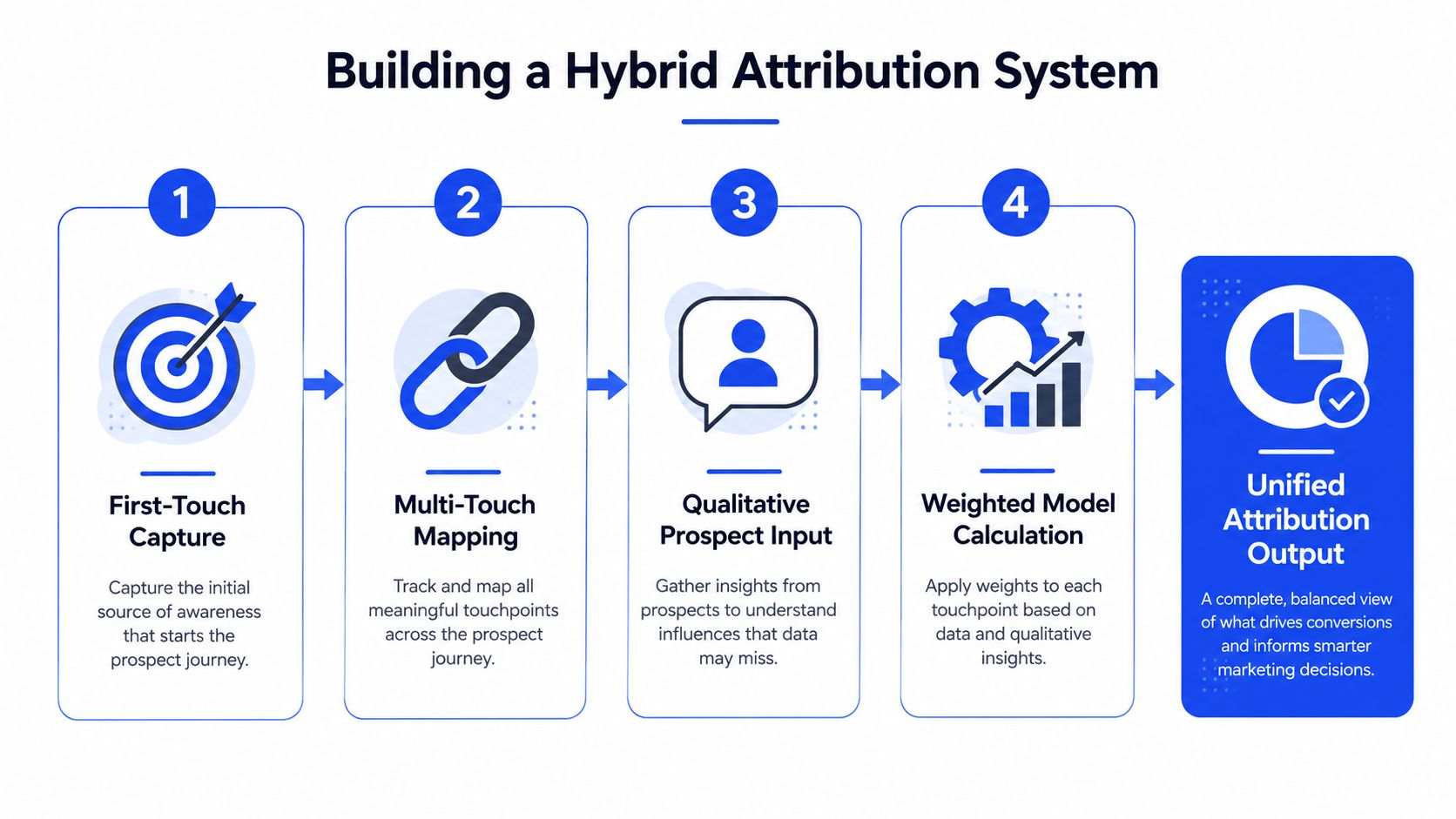
A workable system needs four connected components. The first records where the relationship began. The second distributes contribution across the journey. The third captures what prospects say influenced them. The fourth checks content engagement against later sales activity.
Start with sourcing, then add compound credit
Component one, first-touch sourcing. Record the first known relationship trigger in HubSpot when the prospect is created. Use explicit rules:
Accepted LinkedIn connection: LinkedIn source.
Cold email reply: Email source.
Inbound message after content engagement: LinkedIn content source.
Referral: Referral source.
Event interaction: Event source.
This field answers a narrow but useful question, which channel initiated the relationship. It shouldn't be treated as the full revenue story.
Component two, weighted multi-touch. Reconstruct all meaningful touches tied to the closed deal, then distribute 100% of attribution across the journey. Our position-based starting point assigns 30% to the first touch, 30% to the last touch, and 40% across middle touches. Meeting touches receive more weight than ordinary communications, content engagement receives moderate weight, and outbound touches are adjusted based on response.
The weighting is a decision framework, not a discovered law. Different programs may need different rules, but the rules must remain visible and consistent.
Add the information software misses
Component three, qualitative prospect input. Ask during discovery:
→ “How did you first hear about us or our founder?”
→ “What content or interactions were most meaningful in your evaluation?”
→ “What ultimately convinced you to move forward?”
→ “Who else at your company was involved in the decision, and what influenced them?”
Record the answers in the CRM, preferably close to the prospect's wording. This catches content, referrals, conversations, and other influences that may not appear in click data.
Component four, cross-referenced engagement. Track LinkedIn interactions in Sales Navigator, then compare engagement timing with outbound replies, meetings, and opportunity creation. A substantive comment should carry more interpretive weight than a passive like. Multiple engagements and recent interaction before a meeting provide stronger evidence than an old, isolated signal.
The five rules below keep LinkedIn content and outbound credit from collapsing into one channel:
Outbound conversion without prior content engagement: Assign 100% to outbound when the first and closing touches are outbound.
Outbound conversion after content engagement: Credit content for warming, typically 20% to 30%, and outbound for conversion, typically 70% to 80%.
Content-led inbound without prior outbound: Assign 100% to LinkedIn content when content initiated and continued the conversation.
Content sourcing followed by outbound acceleration: Credit content for sourcing, typically 40% to 50%, outbound for acceleration, typically 30% to 40%, and meetings or follow-up for closing, typically 20% to 30%.
Multi-touch across both channels: Apply position-based weighting with touch-type adjustments and document the reasoning.
This is the operating logic behind Grou's multi-touch attribution approach. It gives content a fair chance to receive credit without claiming that every outbound conversion was caused by a post.
When multi-touch attribution reveals unexpected pipeline drivers
A B2B SaaS client in the revenue operations category assumed cold outbound drove most pipeline. The company had around 90 employees, focused on the mid-market, and carried an average ACV of €58k. At month six of a nine-month measurement period, the team estimated outbound contribution at 60% to 70% because outbound produced the most visible reply activity.
The reconstruction covered 28 closed deals. The team documented first touch, interim touches, final touch, prospect explanations, content engagement, outbound sequences, meetings, and events before applying weighted attribution.

The actual result reversed the team's assumption:
Founder LinkedIn content: 42% of pipeline value
Cold outbound: 34% of pipeline value
Meetings and sales process: 18%
Other touches: 6%
The result wasn't a claim that content always beats outbound. It showed that the visible volume of outbound work had obscured the accumulated influence of founder content.
What the deal review exposed
18 of 28 closed deals had prior content engagement, equal to 64%, and 11 of 28 deals, equal to 39%, cited content as a primary influence. Content-engaged prospects replied at 18.4%, compared with 5.8% for prospects without prior content engagement, a 3.2x difference. Those figures come from the client's reconstruction, not a universal benchmark.
Content-sourced deals also carried an average ACV of €71k, compared with €51k for outbound-sourced deals. Content-sourced qualified opportunities closed at 52%, compared with 31% for outbound-sourced qualified opportunities. The team had been measuring activity intensity, while the analysis measured influence across the buying path.
The most active channel in a dashboard may be the channel doing the most visible work, not the channel creating the most valuable conditions for a deal.
What changed afterward
The client protected founder time for 2 to 3 posts weekly, prioritized content quality, and added content engagement to outbound targeting. Outbound conversations began informing content topics, while reports separated content warming from direct inbound sourcing.
Content investment increased 30% while outbound investment was maintained. Over the following six months, overall pipeline generation improved 45%, and cost per qualified opportunity fell 32%. The case illustrates why attribution should inform decisions without being presented as absolute truth.
A related video is included below for teams that want a visual explanation of how attribution can change the perceived pipeline driver.
The original assumption came from visibility bias, reporting cadence, and a simple belief that the hardest daily work must be producing the most revenue. The reconstruction made the compound effect observable enough to change investment.
Attributing offline meetings and phone calls to digital touchpoints
Offline attribution is imperfect by nature. A meeting may follow months of content exposure, an outbound sequence, a referral, an event conversation, and a phone call. No single system will recover every influence, so confidence should be recorded alongside the credit.
Use five evidence sources
First, ask the prospect directly. AEs can open discovery with, “Before we get into today, I'm curious, how did you first hear about us?” Follow with, “Have you seen any of our content or engaged with us before?” and “What specifically motivated you to book this meeting?” Record responses in HubSpot meeting notes.
Second, reconstruct CRM history. Export the prospect's prior outreach, connection dates, meeting requests, rescheduling, and email activity. Treat opens cautiously because their reliability varies. The purpose is to build a timeline, not to pretend every event proves influence.
Third, cross-reference LinkedIn activity. Track likes, substantive comments, connections with team members, company-page following, and visible content interactions. A meaningful comment generally carries stronger evidence than a passive like, while recent engagement near the meeting deserves more weight than distant activity.
Fourth, compare content topics with the meeting. Note themes published during the preceding 30 days, then record whether the prospect references a specific framework, post, or idea. A direct reference gives stronger evidence than a general similarity.
Fifth, map phone calls to the prior sequence. For outbound calls, treat email and LinkedIn as sourcing or warming touches, then evaluate the phone call as acceleration or closing. For inbound calls after content engagement, credit content as the likely source and the phone conversation as the response event. Referral-led calls should preserve the referral as the dominant source when the evidence supports it.
For teams evaluating call-tracking infrastructure, CallRail's call attribution capabilities provide a relevant reference point, but tool data still needs CRM context and prospect confirmation.
Report confidence instead of false precision
Use three confidence categories:
High confidence: Prospect self-reporting, 40% to 50% of attributions.
Moderate confidence: Clear touch pattern, 30% to 40% of attributions.
Low confidence: Limited touch data, 15% to 25% of attributions.
These ranges describe the operating distribution in this methodology, not a universal industry benchmark. If the history is missing, mark an attribution gap instead of filling the field with a guess.
One in-person event meeting made the process concrete. The prospect mentioned a LinkedIn post about “signal-triggered intake,” had engaged through 4 substantive comments over 4 months, and had also received 2 cold outbound email touches, 1 outbound meeting request, 2 event interactions, and a phone call. The final allocation gave founder LinkedIn content 55%, cold outbound 20%, event interaction 15%, and the phone call 10%.
The prospect's statement, engagement record, meeting discussion, and touch history all pointed in the same direction. That convergence created high confidence. It still didn't create certainty.
The attribution tech stack and reporting cadence that works
A practical stack doesn't need a dedicated attribution platform to be useful. It needs one authoritative CRM, consistent field definitions, reliable integrations, and a calculation layer that the team can inspect.
The foundation is HubSpot as the source of truth, with Clay for prospect orchestration, LinkedIn Sales Navigator for engagement tracking, Apollo for enrichment, and Lemlist or Instantly for email execution. HeyReach can support LinkedIn workflows, while Slack routes replies and Notion stores methodology. Fathom or Fireflies can preserve meeting language that matters for qualitative attribution.
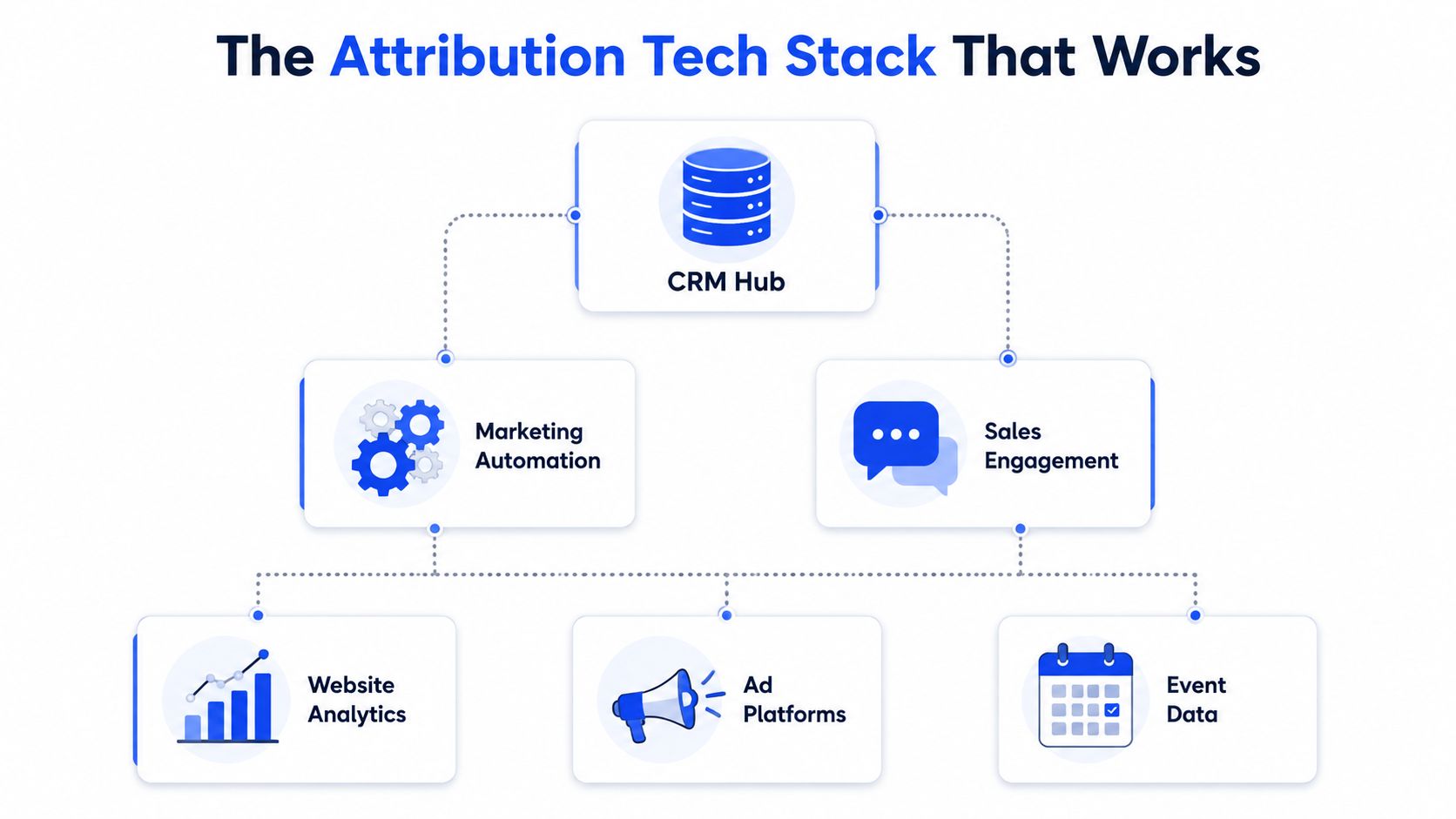
Custom Google Sheets remain useful for weighted calculations because the team can inspect every rule, adjust a weighting, and explain the result to a client. Dedicated platforms may offer algorithmic attribution, but teams often struggle to verify proprietary logic. For a pipeline agency running compound LinkedIn and outbound programs, explainability can matter more than automated sophistication.
Teams should also separate deliverability and activity reporting from pipeline attribution. A practical reference for cold outreach reporting metrics can help define execution measures, while HubSpot should hold the revenue and opportunity context.
Match reporting frequency to the decision
Daily monitoring should be automated and internal. Check bounce rate, spam complaints, domain reputation, reply routing, and system health. Google Postmaster Tools and deliverability monitoring belong here, not in a quarterly executive narrative.
Weekly operational reviews take 30 minutes with the client. Cover prospect volume, reply quality, meetings, show rates, qualification, pipeline creation, and infrastructure health. Keep the report to 1 to 2 pages, with issues and planned adjustments visible.
Monthly strategic reviews run 60 to 90 minutes. Review funnel performance, cost per qualified opportunity trends, sales-cycle movement, channel comparison, and attribution patterns. A 4 to 6 page report is enough when it includes decisions rather than decorative charts.
Quarterly executive reviews run 90 to 120 minutes and cover pipeline value, ROI calculations, strategic positioning, and investment choices. The report can run 8 to 12 pages when executives need the underlying reasoning.
Transparency has five practical parts:
→ Client-accessible dashboards with raw data
→ Direct reporting of underperformance
→ Documented metric and attribution definitions
→ Calculations that stakeholders can inspect
→ Support for independent verification
A reporting cadence is only useful when definitions stay stable. If “qualified opportunity” changes mid-quarter or attribution rules shift without a note, historical comparisons become unreliable. The operating discipline matters more than the logo collection.
Teams can use this reporting cadence guide to align review frequency with decision type. Grou uses this kind of stack to connect LinkedIn content, lead generation, and outbound activity into one reporting line, with HubSpot as the central record rather than a hidden agency dashboard.
Common attribution mistakes and your next implementation step
Five problems undermine most B2B attribution systems:
Incomplete touch tracking: Important content, phone, event, and referral interactions never reach the CRM.
Inconsistent rules: Different reps classify identical journeys differently.
Missing qualitative input: Prospect explanations are ignored even when software lacks the signal.
Assumption-led analysis: Visible activity gets mistaken for causal influence.
Single-model reliance: One lens governs every budget decision.
AI discovery adds another blind spot. 48% of agencies identify tracking AI-driven discovery, including prospects who find brands through ChatGPT or AI Overviews, as their hardest attribution problem, according to AgencyAnalytics' attribution benchmark. Buyers may arrive after an opaque discovery path with no trackable click.
Add four CRM fields this week: first-touch source, last meaningful touch, qualitative influence, and attribution confidence. Then review the last 10 closed or advanced opportunities, reconstruct the touch history, ask sales what the prospect said, and mark every unverified assumption. That audit will show whether your dashboard measures the buyer journey or only the part your tools happen to record.
GROU is a global B2B pipeline agency trusted by 50+ companies across iGaming, SaaS, manufacturing, and professional services. Its methodology combines ICP-aligned list building, LinkedIn content, outbound sequences, fast reply routing, and transparent pipeline reporting.
Grou helps B2B teams connect content warming, outbound execution, and revenue attribution into a single operating system. Visit Grou to assess your current measurement coverage and build a reporting structure your sales and marketing teams can use.
Most B2B teams don't have an attribution model problem. They have a measurement coverage problem disguised as a model-selection debate. First-touch, last-touch, and multi-touch reporting can all produce tidy numbers while missing the content, conversations, referrals, and offline interactions that shaped the deal.
A hybrid system gives pipeline teams a better operating view than a single model.
Weighted multi-touch should be the quantitative foundation for compound programs.
Prospect conversations are essential for recovering influence that software can't see.
LinkedIn content can warm outbound without receiving obvious conversion credit.
Transparent rules matter more than a supposedly perfect algorithm.
That distinction matters across SaaS, iGaming, manufacturing, legal tech, and pharma. Structure turns attention into pipeline only when the structure records enough of the buyer journey to support a decision.
Table of Contents
Why most attribution systems produce misleading pipeline data
Building a hybrid attribution system for compound B2B programs
When multi-touch attribution reveals unexpected pipeline drivers
Attributing offline meetings and phone calls to digital touchpoints
Common attribution mistakes and your next implementation step
Why most attribution systems produce misleading pipeline data
The popular advice is to choose an attribution model and let its output set the budget. That approach fails when the underlying system captures only a fraction of the buyer journey. A model can assign credit only to touchpoints that your platforms recorded, joined, and classified consistently.
The gap appears in the confidence data. 85% of marketers report being very or extremely confident in ROI measurement, while only 32% measure media spending across digital and traditional channels, according to OmniBound's 2026 attribution confidence survey. Confidence is ahead of actual measurement coverage.
That creates a misleading operating view. A founder sees campaign-sourced pipeline, a sales leader sees booked meetings, and RevOps sees completed CRM fields. Each view may be accurate within its own system while still missing other evidence. A prospect can read a founder's LinkedIn content, reply to an outbound email, attend an event, and mention a referral during discovery. A last-touch report may compress that sequence into one conversion event, while understanding influenced pipeline attribution requires recording the wider set of interactions that shaped the opportunity.
Practical rule: Treat attribution as a data governance discipline before treating it as a mathematical model.
Coverage breaks before the model does
Incomplete touch tracking is the first failure. Prospects consume content without clicking, discuss vendors internally, and share recommendations in conversations that leave no reliable digital record. Privacy changes and signal loss make user-level paths less complete, so serious teams need first-party data, experiments, and modeled measurement alongside click logs.
The distinction between attribution and incrementality matters. Attribution and incrementality research describes attribution as assigning credit to observable touchpoints, while incrementality estimates causal lift through randomization. Attribution asks, “Which recorded interactions appeared in this journey?” Incrementality asks, “What changed because this marketing activity occurred?” They answer different questions, and one cannot replace the other.
Rule inconsistency creates another failure. One rep marks an accepted LinkedIn connection as the source. Another records the first meeting. A third leaves the field blank because the prospect arrived through a referral. The dashboard still produces a result, but that result reflects data-entry habits more than channel performance.
Confidence needs a counterweight
Organizations using multi-touch attribution reported measuring an average of 31% of media budget with it in MMA Global's 2021 benchmark. More than one in three companies in the implementation process had already failed in a previous attempt, according to the MMA Global benchmark survey. Adoption does not prove measurement quality.
Marketing attribution should carry confidence labels, documented gaps, and a stated purpose. First-touch can identify the channel that initiated demand. Multi-touch can estimate compound contribution. Prospect self-reporting can recover dark social and content influence. Incrementality tests can challenge whether an observed association reflects causal impact.
If the team cannot explain which touchpoints are included, which are excluded, and why every deal follows the same rules, changing the model will not fix the dashboard. Start with coverage, definitions, and operating discipline.
Attribution models explained with a clear recommendation
Weighted multi-touch attribution is the right foundation for B2B pipeline teams running LinkedIn content, outbound, events, and sales-led follow-up. Keep first-touch as a sourcing lens and use last-touch for closing analysis, but don't let either model govern investment decisions alone.
First-touch assigns all credit to the first recorded interaction. It's useful for sourcing because it reveals which channel initiated a relationship. It fails when early awareness receives all the credit even though meetings, content, outbound, and sales work created the conditions for a deal.
Last-touch assigns all credit to the final recorded interaction before conversion. It can help analyze the immediate conversion trigger. It also erases the earlier warming that made the final action possible, especially in a long B2B sales cycle.
Multi-touch distributes credit across the buyer journey. Nielsen describes it as considering all touchpoints and dividing influence across channels in its guide to multi-touch attribution. That makes it more suitable for compound programs, but the weighting still requires judgment.
Algorithmic attribution can add scale, yet proprietary weighting often hides the decision logic. If your team can't inspect why a meeting received credit or challenge the underlying identity join, the system may be convenient without being trustworthy.
The practical comparison
Model | Credit assignment | B2B failure mode | Best for |
|---|---|---|---|
First-touch | All credit goes to the first recorded touch | Overweights sourcing and ignores later influence | Channel sourcing |
Last-touch | All credit goes to the final recorded touch | Overweights the closing action and erases warming | Conversion-trigger analysis |
Multi-touch | Credit is distributed across recorded touches | Weighting can become arbitrary without rules | Pipeline and channel analysis |
Algorithmic | A system calculates credit from modeled behavior | Logic may be opaque or difficult to validate | Large data environments with strong governance |
Named weighting rules make multi-touch less vague. Linear attribution gives equal credit to every touchpoint. Time-decay gives more credit to later touches. U-shaped attribution gives 40% each to the first and last touchpoints, with the remaining 20% split across middle touches, while W-shaped attribution gives 30% each to the first, middle lead-creation, and last touchpoints, with the remaining 10% split across other touches, according to Adjust's multi-touch attribution guide.
Our recommendation is position-based weighting with touch-type adjustments. A meeting should carry more practical weight than a passive communication, while content engagement should receive meaningful credit when it clearly precedes an outbound response or meeting. That approach is more useful than treating every event as equal, and it remains explainable to sales, finance, and leadership.
Teams that need the mechanics can use this attribution model reference to align terminology before setting rules. The important decision is not whether every model tells the same story. It's whether the chosen model answers the business question without pretending to capture unobserved influence.
Building a hybrid attribution system for compound B2B programs
A workable system needs four connected components. The first records where the relationship began. The second distributes contribution across the journey. The third captures what prospects say influenced them. The fourth checks content engagement against later sales activity.
Start with sourcing, then add compound credit
Component one, first-touch sourcing. Record the first known relationship trigger in HubSpot when the prospect is created. Use explicit rules:
Accepted LinkedIn connection: LinkedIn source.
Cold email reply: Email source.
Inbound message after content engagement: LinkedIn content source.
Referral: Referral source.
Event interaction: Event source.
This field answers a narrow but useful question, which channel initiated the relationship. It shouldn't be treated as the full revenue story.
Component two, weighted multi-touch. Reconstruct all meaningful touches tied to the closed deal, then distribute 100% of attribution across the journey. Our position-based starting point assigns 30% to the first touch, 30% to the last touch, and 40% across middle touches. Meeting touches receive more weight than ordinary communications, content engagement receives moderate weight, and outbound touches are adjusted based on response.
The weighting is a decision framework, not a discovered law. Different programs may need different rules, but the rules must remain visible and consistent.
Add the information software misses
Component three, qualitative prospect input. Ask during discovery:
→ “How did you first hear about us or our founder?”
→ “What content or interactions were most meaningful in your evaluation?”
→ “What ultimately convinced you to move forward?”
→ “Who else at your company was involved in the decision, and what influenced them?”
Record the answers in the CRM, preferably close to the prospect's wording. This catches content, referrals, conversations, and other influences that may not appear in click data.
Component four, cross-referenced engagement. Track LinkedIn interactions in Sales Navigator, then compare engagement timing with outbound replies, meetings, and opportunity creation. A substantive comment should carry more interpretive weight than a passive like. Multiple engagements and recent interaction before a meeting provide stronger evidence than an old, isolated signal.
The five rules below keep LinkedIn content and outbound credit from collapsing into one channel:
Outbound conversion without prior content engagement: Assign 100% to outbound when the first and closing touches are outbound.
Outbound conversion after content engagement: Credit content for warming, typically 20% to 30%, and outbound for conversion, typically 70% to 80%.
Content-led inbound without prior outbound: Assign 100% to LinkedIn content when content initiated and continued the conversation.
Content sourcing followed by outbound acceleration: Credit content for sourcing, typically 40% to 50%, outbound for acceleration, typically 30% to 40%, and meetings or follow-up for closing, typically 20% to 30%.
Multi-touch across both channels: Apply position-based weighting with touch-type adjustments and document the reasoning.
This is the operating logic behind Grou's multi-touch attribution approach. It gives content a fair chance to receive credit without claiming that every outbound conversion was caused by a post.
When multi-touch attribution reveals unexpected pipeline drivers
A B2B SaaS client in the revenue operations category assumed cold outbound drove most pipeline. The company had around 90 employees, focused on the mid-market, and carried an average ACV of €58k. At month six of a nine-month measurement period, the team estimated outbound contribution at 60% to 70% because outbound produced the most visible reply activity.
The reconstruction covered 28 closed deals. The team documented first touch, interim touches, final touch, prospect explanations, content engagement, outbound sequences, meetings, and events before applying weighted attribution.
The actual result reversed the team's assumption:
Founder LinkedIn content: 42% of pipeline value
Cold outbound: 34% of pipeline value
Meetings and sales process: 18%
Other touches: 6%
The result wasn't a claim that content always beats outbound. It showed that the visible volume of outbound work had obscured the accumulated influence of founder content.
What the deal review exposed
18 of 28 closed deals had prior content engagement, equal to 64%, and 11 of 28 deals, equal to 39%, cited content as a primary influence. Content-engaged prospects replied at 18.4%, compared with 5.8% for prospects without prior content engagement, a 3.2x difference. Those figures come from the client's reconstruction, not a universal benchmark.
Content-sourced deals also carried an average ACV of €71k, compared with €51k for outbound-sourced deals. Content-sourced qualified opportunities closed at 52%, compared with 31% for outbound-sourced qualified opportunities. The team had been measuring activity intensity, while the analysis measured influence across the buying path.
The most active channel in a dashboard may be the channel doing the most visible work, not the channel creating the most valuable conditions for a deal.
What changed afterward
The client protected founder time for 2 to 3 posts weekly, prioritized content quality, and added content engagement to outbound targeting. Outbound conversations began informing content topics, while reports separated content warming from direct inbound sourcing.
Content investment increased 30% while outbound investment was maintained. Over the following six months, overall pipeline generation improved 45%, and cost per qualified opportunity fell 32%. The case illustrates why attribution should inform decisions without being presented as absolute truth.
A related video is included below for teams that want a visual explanation of how attribution can change the perceived pipeline driver.
The original assumption came from visibility bias, reporting cadence, and a simple belief that the hardest daily work must be producing the most revenue. The reconstruction made the compound effect observable enough to change investment.
Attributing offline meetings and phone calls to digital touchpoints
Offline attribution is imperfect by nature. A meeting may follow months of content exposure, an outbound sequence, a referral, an event conversation, and a phone call. No single system will recover every influence, so confidence should be recorded alongside the credit.
Use five evidence sources
First, ask the prospect directly. AEs can open discovery with, “Before we get into today, I'm curious, how did you first hear about us?” Follow with, “Have you seen any of our content or engaged with us before?” and “What specifically motivated you to book this meeting?” Record responses in HubSpot meeting notes.
Second, reconstruct CRM history. Export the prospect's prior outreach, connection dates, meeting requests, rescheduling, and email activity. Treat opens cautiously because their reliability varies. The purpose is to build a timeline, not to pretend every event proves influence.
Third, cross-reference LinkedIn activity. Track likes, substantive comments, connections with team members, company-page following, and visible content interactions. A meaningful comment generally carries stronger evidence than a passive like, while recent engagement near the meeting deserves more weight than distant activity.
Fourth, compare content topics with the meeting. Note themes published during the preceding 30 days, then record whether the prospect references a specific framework, post, or idea. A direct reference gives stronger evidence than a general similarity.
Fifth, map phone calls to the prior sequence. For outbound calls, treat email and LinkedIn as sourcing or warming touches, then evaluate the phone call as acceleration or closing. For inbound calls after content engagement, credit content as the likely source and the phone conversation as the response event. Referral-led calls should preserve the referral as the dominant source when the evidence supports it.
For teams evaluating call-tracking infrastructure, CallRail's call attribution capabilities provide a relevant reference point, but tool data still needs CRM context and prospect confirmation.
Report confidence instead of false precision
Use three confidence categories:
High confidence: Prospect self-reporting, 40% to 50% of attributions.
Moderate confidence: Clear touch pattern, 30% to 40% of attributions.
Low confidence: Limited touch data, 15% to 25% of attributions.
These ranges describe the operating distribution in this methodology, not a universal industry benchmark. If the history is missing, mark an attribution gap instead of filling the field with a guess.
One in-person event meeting made the process concrete. The prospect mentioned a LinkedIn post about “signal-triggered intake,” had engaged through 4 substantive comments over 4 months, and had also received 2 cold outbound email touches, 1 outbound meeting request, 2 event interactions, and a phone call. The final allocation gave founder LinkedIn content 55%, cold outbound 20%, event interaction 15%, and the phone call 10%.
The prospect's statement, engagement record, meeting discussion, and touch history all pointed in the same direction. That convergence created high confidence. It still didn't create certainty.
The attribution tech stack and reporting cadence that works
A practical stack doesn't need a dedicated attribution platform to be useful. It needs one authoritative CRM, consistent field definitions, reliable integrations, and a calculation layer that the team can inspect.
The foundation is HubSpot as the source of truth, with Clay for prospect orchestration, LinkedIn Sales Navigator for engagement tracking, Apollo for enrichment, and Lemlist or Instantly for email execution. HeyReach can support LinkedIn workflows, while Slack routes replies and Notion stores methodology. Fathom or Fireflies can preserve meeting language that matters for qualitative attribution.
Custom Google Sheets remain useful for weighted calculations because the team can inspect every rule, adjust a weighting, and explain the result to a client. Dedicated platforms may offer algorithmic attribution, but teams often struggle to verify proprietary logic. For a pipeline agency running compound LinkedIn and outbound programs, explainability can matter more than automated sophistication.
Teams should also separate deliverability and activity reporting from pipeline attribution. A practical reference for cold outreach reporting metrics can help define execution measures, while HubSpot should hold the revenue and opportunity context.
Match reporting frequency to the decision
Daily monitoring should be automated and internal. Check bounce rate, spam complaints, domain reputation, reply routing, and system health. Google Postmaster Tools and deliverability monitoring belong here, not in a quarterly executive narrative.
Weekly operational reviews take 30 minutes with the client. Cover prospect volume, reply quality, meetings, show rates, qualification, pipeline creation, and infrastructure health. Keep the report to 1 to 2 pages, with issues and planned adjustments visible.
Monthly strategic reviews run 60 to 90 minutes. Review funnel performance, cost per qualified opportunity trends, sales-cycle movement, channel comparison, and attribution patterns. A 4 to 6 page report is enough when it includes decisions rather than decorative charts.
Quarterly executive reviews run 90 to 120 minutes and cover pipeline value, ROI calculations, strategic positioning, and investment choices. The report can run 8 to 12 pages when executives need the underlying reasoning.
Transparency has five practical parts:
→ Client-accessible dashboards with raw data
→ Direct reporting of underperformance
→ Documented metric and attribution definitions
→ Calculations that stakeholders can inspect
→ Support for independent verification
A reporting cadence is only useful when definitions stay stable. If “qualified opportunity” changes mid-quarter or attribution rules shift without a note, historical comparisons become unreliable. The operating discipline matters more than the logo collection.
Teams can use this reporting cadence guide to align review frequency with decision type. Grou uses this kind of stack to connect LinkedIn content, lead generation, and outbound activity into one reporting line, with HubSpot as the central record rather than a hidden agency dashboard.
Common attribution mistakes and your next implementation step
Five problems undermine most B2B attribution systems:
Incomplete touch tracking: Important content, phone, event, and referral interactions never reach the CRM.
Inconsistent rules: Different reps classify identical journeys differently.
Missing qualitative input: Prospect explanations are ignored even when software lacks the signal.
Assumption-led analysis: Visible activity gets mistaken for causal influence.
Single-model reliance: One lens governs every budget decision.
AI discovery adds another blind spot. 48% of agencies identify tracking AI-driven discovery, including prospects who find brands through ChatGPT or AI Overviews, as their hardest attribution problem, according to AgencyAnalytics' attribution benchmark. Buyers may arrive after an opaque discovery path with no trackable click.
Add four CRM fields this week: first-touch source, last meaningful touch, qualitative influence, and attribution confidence. Then review the last 10 closed or advanced opportunities, reconstruct the touch history, ask sales what the prospect said, and mark every unverified assumption. That audit will show whether your dashboard measures the buyer journey or only the part your tools happen to record.
GROU is a global B2B pipeline agency trusted by 50+ companies across iGaming, SaaS, manufacturing, and professional services. Its methodology combines ICP-aligned list building, LinkedIn content, outbound sequences, fast reply routing, and transparent pipeline reporting.
Grou helps B2B teams connect content warming, outbound execution, and revenue attribution into a single operating system. Visit Grou to assess your current measurement coverage and build a reporting structure your sales and marketing teams can use.
Most B2B teams don't have an attribution model problem. They have a measurement coverage problem disguised as a model-selection debate. First-touch, last-touch, and multi-touch reporting can all produce tidy numbers while missing the content, conversations, referrals, and offline interactions that shaped the deal.
A hybrid system gives pipeline teams a better operating view than a single model.
Weighted multi-touch should be the quantitative foundation for compound programs.
Prospect conversations are essential for recovering influence that software can't see.
LinkedIn content can warm outbound without receiving obvious conversion credit.
Transparent rules matter more than a supposedly perfect algorithm.
That distinction matters across SaaS, iGaming, manufacturing, legal tech, and pharma. Structure turns attention into pipeline only when the structure records enough of the buyer journey to support a decision.
Table of Contents
Why most attribution systems produce misleading pipeline data
Building a hybrid attribution system for compound B2B programs
When multi-touch attribution reveals unexpected pipeline drivers
Attributing offline meetings and phone calls to digital touchpoints
Common attribution mistakes and your next implementation step
Why most attribution systems produce misleading pipeline data
The popular advice is to choose an attribution model and let its output set the budget. That approach fails when the underlying system captures only a fraction of the buyer journey. A model can assign credit only to touchpoints that your platforms recorded, joined, and classified consistently.
The gap appears in the confidence data. 85% of marketers report being very or extremely confident in ROI measurement, while only 32% measure media spending across digital and traditional channels, according to OmniBound's 2026 attribution confidence survey. Confidence is ahead of actual measurement coverage.
That creates a misleading operating view. A founder sees campaign-sourced pipeline, a sales leader sees booked meetings, and RevOps sees completed CRM fields. Each view may be accurate within its own system while still missing other evidence. A prospect can read a founder's LinkedIn content, reply to an outbound email, attend an event, and mention a referral during discovery. A last-touch report may compress that sequence into one conversion event, while understanding influenced pipeline attribution requires recording the wider set of interactions that shaped the opportunity.
Practical rule: Treat attribution as a data governance discipline before treating it as a mathematical model.
Coverage breaks before the model does
Incomplete touch tracking is the first failure. Prospects consume content without clicking, discuss vendors internally, and share recommendations in conversations that leave no reliable digital record. Privacy changes and signal loss make user-level paths less complete, so serious teams need first-party data, experiments, and modeled measurement alongside click logs.
The distinction between attribution and incrementality matters. Attribution and incrementality research describes attribution as assigning credit to observable touchpoints, while incrementality estimates causal lift through randomization. Attribution asks, “Which recorded interactions appeared in this journey?” Incrementality asks, “What changed because this marketing activity occurred?” They answer different questions, and one cannot replace the other.
Rule inconsistency creates another failure. One rep marks an accepted LinkedIn connection as the source. Another records the first meeting. A third leaves the field blank because the prospect arrived through a referral. The dashboard still produces a result, but that result reflects data-entry habits more than channel performance.
Confidence needs a counterweight
Organizations using multi-touch attribution reported measuring an average of 31% of media budget with it in MMA Global's 2021 benchmark. More than one in three companies in the implementation process had already failed in a previous attempt, according to the MMA Global benchmark survey. Adoption does not prove measurement quality.
Marketing attribution should carry confidence labels, documented gaps, and a stated purpose. First-touch can identify the channel that initiated demand. Multi-touch can estimate compound contribution. Prospect self-reporting can recover dark social and content influence. Incrementality tests can challenge whether an observed association reflects causal impact.
If the team cannot explain which touchpoints are included, which are excluded, and why every deal follows the same rules, changing the model will not fix the dashboard. Start with coverage, definitions, and operating discipline.
Attribution models explained with a clear recommendation
Weighted multi-touch attribution is the right foundation for B2B pipeline teams running LinkedIn content, outbound, events, and sales-led follow-up. Keep first-touch as a sourcing lens and use last-touch for closing analysis, but don't let either model govern investment decisions alone.
First-touch assigns all credit to the first recorded interaction. It's useful for sourcing because it reveals which channel initiated a relationship. It fails when early awareness receives all the credit even though meetings, content, outbound, and sales work created the conditions for a deal.
Last-touch assigns all credit to the final recorded interaction before conversion. It can help analyze the immediate conversion trigger. It also erases the earlier warming that made the final action possible, especially in a long B2B sales cycle.
Multi-touch distributes credit across the buyer journey. Nielsen describes it as considering all touchpoints and dividing influence across channels in its guide to multi-touch attribution. That makes it more suitable for compound programs, but the weighting still requires judgment.
Algorithmic attribution can add scale, yet proprietary weighting often hides the decision logic. If your team can't inspect why a meeting received credit or challenge the underlying identity join, the system may be convenient without being trustworthy.
The practical comparison
Model | Credit assignment | B2B failure mode | Best for |
|---|---|---|---|
First-touch | All credit goes to the first recorded touch | Overweights sourcing and ignores later influence | Channel sourcing |
Last-touch | All credit goes to the final recorded touch | Overweights the closing action and erases warming | Conversion-trigger analysis |
Multi-touch | Credit is distributed across recorded touches | Weighting can become arbitrary without rules | Pipeline and channel analysis |
Algorithmic | A system calculates credit from modeled behavior | Logic may be opaque or difficult to validate | Large data environments with strong governance |
Named weighting rules make multi-touch less vague. Linear attribution gives equal credit to every touchpoint. Time-decay gives more credit to later touches. U-shaped attribution gives 40% each to the first and last touchpoints, with the remaining 20% split across middle touches, while W-shaped attribution gives 30% each to the first, middle lead-creation, and last touchpoints, with the remaining 10% split across other touches, according to Adjust's multi-touch attribution guide.
Our recommendation is position-based weighting with touch-type adjustments. A meeting should carry more practical weight than a passive communication, while content engagement should receive meaningful credit when it clearly precedes an outbound response or meeting. That approach is more useful than treating every event as equal, and it remains explainable to sales, finance, and leadership.
Teams that need the mechanics can use this attribution model reference to align terminology before setting rules. The important decision is not whether every model tells the same story. It's whether the chosen model answers the business question without pretending to capture unobserved influence.
Building a hybrid attribution system for compound B2B programs
A workable system needs four connected components. The first records where the relationship began. The second distributes contribution across the journey. The third captures what prospects say influenced them. The fourth checks content engagement against later sales activity.
Start with sourcing, then add compound credit
Component one, first-touch sourcing. Record the first known relationship trigger in HubSpot when the prospect is created. Use explicit rules:
Accepted LinkedIn connection: LinkedIn source.
Cold email reply: Email source.
Inbound message after content engagement: LinkedIn content source.
Referral: Referral source.
Event interaction: Event source.
This field answers a narrow but useful question, which channel initiated the relationship. It shouldn't be treated as the full revenue story.
Component two, weighted multi-touch. Reconstruct all meaningful touches tied to the closed deal, then distribute 100% of attribution across the journey. Our position-based starting point assigns 30% to the first touch, 30% to the last touch, and 40% across middle touches. Meeting touches receive more weight than ordinary communications, content engagement receives moderate weight, and outbound touches are adjusted based on response.
The weighting is a decision framework, not a discovered law. Different programs may need different rules, but the rules must remain visible and consistent.
Add the information software misses
Component three, qualitative prospect input. Ask during discovery:
→ “How did you first hear about us or our founder?”
→ “What content or interactions were most meaningful in your evaluation?”
→ “What ultimately convinced you to move forward?”
→ “Who else at your company was involved in the decision, and what influenced them?”
Record the answers in the CRM, preferably close to the prospect's wording. This catches content, referrals, conversations, and other influences that may not appear in click data.
Component four, cross-referenced engagement. Track LinkedIn interactions in Sales Navigator, then compare engagement timing with outbound replies, meetings, and opportunity creation. A substantive comment should carry more interpretive weight than a passive like. Multiple engagements and recent interaction before a meeting provide stronger evidence than an old, isolated signal.
The five rules below keep LinkedIn content and outbound credit from collapsing into one channel:
Outbound conversion without prior content engagement: Assign 100% to outbound when the first and closing touches are outbound.
Outbound conversion after content engagement: Credit content for warming, typically 20% to 30%, and outbound for conversion, typically 70% to 80%.
Content-led inbound without prior outbound: Assign 100% to LinkedIn content when content initiated and continued the conversation.
Content sourcing followed by outbound acceleration: Credit content for sourcing, typically 40% to 50%, outbound for acceleration, typically 30% to 40%, and meetings or follow-up for closing, typically 20% to 30%.
Multi-touch across both channels: Apply position-based weighting with touch-type adjustments and document the reasoning.
This is the operating logic behind Grou's multi-touch attribution approach. It gives content a fair chance to receive credit without claiming that every outbound conversion was caused by a post.
When multi-touch attribution reveals unexpected pipeline drivers
A B2B SaaS client in the revenue operations category assumed cold outbound drove most pipeline. The company had around 90 employees, focused on the mid-market, and carried an average ACV of €58k. At month six of a nine-month measurement period, the team estimated outbound contribution at 60% to 70% because outbound produced the most visible reply activity.
The reconstruction covered 28 closed deals. The team documented first touch, interim touches, final touch, prospect explanations, content engagement, outbound sequences, meetings, and events before applying weighted attribution.
The actual result reversed the team's assumption:
Founder LinkedIn content: 42% of pipeline value
Cold outbound: 34% of pipeline value
Meetings and sales process: 18%
Other touches: 6%
The result wasn't a claim that content always beats outbound. It showed that the visible volume of outbound work had obscured the accumulated influence of founder content.
What the deal review exposed
18 of 28 closed deals had prior content engagement, equal to 64%, and 11 of 28 deals, equal to 39%, cited content as a primary influence. Content-engaged prospects replied at 18.4%, compared with 5.8% for prospects without prior content engagement, a 3.2x difference. Those figures come from the client's reconstruction, not a universal benchmark.
Content-sourced deals also carried an average ACV of €71k, compared with €51k for outbound-sourced deals. Content-sourced qualified opportunities closed at 52%, compared with 31% for outbound-sourced qualified opportunities. The team had been measuring activity intensity, while the analysis measured influence across the buying path.
The most active channel in a dashboard may be the channel doing the most visible work, not the channel creating the most valuable conditions for a deal.
What changed afterward
The client protected founder time for 2 to 3 posts weekly, prioritized content quality, and added content engagement to outbound targeting. Outbound conversations began informing content topics, while reports separated content warming from direct inbound sourcing.
Content investment increased 30% while outbound investment was maintained. Over the following six months, overall pipeline generation improved 45%, and cost per qualified opportunity fell 32%. The case illustrates why attribution should inform decisions without being presented as absolute truth.
A related video is included below for teams that want a visual explanation of how attribution can change the perceived pipeline driver.
The original assumption came from visibility bias, reporting cadence, and a simple belief that the hardest daily work must be producing the most revenue. The reconstruction made the compound effect observable enough to change investment.
Attributing offline meetings and phone calls to digital touchpoints
Offline attribution is imperfect by nature. A meeting may follow months of content exposure, an outbound sequence, a referral, an event conversation, and a phone call. No single system will recover every influence, so confidence should be recorded alongside the credit.
Use five evidence sources
First, ask the prospect directly. AEs can open discovery with, “Before we get into today, I'm curious, how did you first hear about us?” Follow with, “Have you seen any of our content or engaged with us before?” and “What specifically motivated you to book this meeting?” Record responses in HubSpot meeting notes.
Second, reconstruct CRM history. Export the prospect's prior outreach, connection dates, meeting requests, rescheduling, and email activity. Treat opens cautiously because their reliability varies. The purpose is to build a timeline, not to pretend every event proves influence.
Third, cross-reference LinkedIn activity. Track likes, substantive comments, connections with team members, company-page following, and visible content interactions. A meaningful comment generally carries stronger evidence than a passive like, while recent engagement near the meeting deserves more weight than distant activity.
Fourth, compare content topics with the meeting. Note themes published during the preceding 30 days, then record whether the prospect references a specific framework, post, or idea. A direct reference gives stronger evidence than a general similarity.
Fifth, map phone calls to the prior sequence. For outbound calls, treat email and LinkedIn as sourcing or warming touches, then evaluate the phone call as acceleration or closing. For inbound calls after content engagement, credit content as the likely source and the phone conversation as the response event. Referral-led calls should preserve the referral as the dominant source when the evidence supports it.
For teams evaluating call-tracking infrastructure, CallRail's call attribution capabilities provide a relevant reference point, but tool data still needs CRM context and prospect confirmation.
Report confidence instead of false precision
Use three confidence categories:
High confidence: Prospect self-reporting, 40% to 50% of attributions.
Moderate confidence: Clear touch pattern, 30% to 40% of attributions.
Low confidence: Limited touch data, 15% to 25% of attributions.
These ranges describe the operating distribution in this methodology, not a universal industry benchmark. If the history is missing, mark an attribution gap instead of filling the field with a guess.
One in-person event meeting made the process concrete. The prospect mentioned a LinkedIn post about “signal-triggered intake,” had engaged through 4 substantive comments over 4 months, and had also received 2 cold outbound email touches, 1 outbound meeting request, 2 event interactions, and a phone call. The final allocation gave founder LinkedIn content 55%, cold outbound 20%, event interaction 15%, and the phone call 10%.
The prospect's statement, engagement record, meeting discussion, and touch history all pointed in the same direction. That convergence created high confidence. It still didn't create certainty.
The attribution tech stack and reporting cadence that works
A practical stack doesn't need a dedicated attribution platform to be useful. It needs one authoritative CRM, consistent field definitions, reliable integrations, and a calculation layer that the team can inspect.
The foundation is HubSpot as the source of truth, with Clay for prospect orchestration, LinkedIn Sales Navigator for engagement tracking, Apollo for enrichment, and Lemlist or Instantly for email execution. HeyReach can support LinkedIn workflows, while Slack routes replies and Notion stores methodology. Fathom or Fireflies can preserve meeting language that matters for qualitative attribution.
Custom Google Sheets remain useful for weighted calculations because the team can inspect every rule, adjust a weighting, and explain the result to a client. Dedicated platforms may offer algorithmic attribution, but teams often struggle to verify proprietary logic. For a pipeline agency running compound LinkedIn and outbound programs, explainability can matter more than automated sophistication.
Teams should also separate deliverability and activity reporting from pipeline attribution. A practical reference for cold outreach reporting metrics can help define execution measures, while HubSpot should hold the revenue and opportunity context.
Match reporting frequency to the decision
Daily monitoring should be automated and internal. Check bounce rate, spam complaints, domain reputation, reply routing, and system health. Google Postmaster Tools and deliverability monitoring belong here, not in a quarterly executive narrative.
Weekly operational reviews take 30 minutes with the client. Cover prospect volume, reply quality, meetings, show rates, qualification, pipeline creation, and infrastructure health. Keep the report to 1 to 2 pages, with issues and planned adjustments visible.
Monthly strategic reviews run 60 to 90 minutes. Review funnel performance, cost per qualified opportunity trends, sales-cycle movement, channel comparison, and attribution patterns. A 4 to 6 page report is enough when it includes decisions rather than decorative charts.
Quarterly executive reviews run 90 to 120 minutes and cover pipeline value, ROI calculations, strategic positioning, and investment choices. The report can run 8 to 12 pages when executives need the underlying reasoning.
Transparency has five practical parts:
→ Client-accessible dashboards with raw data
→ Direct reporting of underperformance
→ Documented metric and attribution definitions
→ Calculations that stakeholders can inspect
→ Support for independent verification
A reporting cadence is only useful when definitions stay stable. If “qualified opportunity” changes mid-quarter or attribution rules shift without a note, historical comparisons become unreliable. The operating discipline matters more than the logo collection.
Teams can use this reporting cadence guide to align review frequency with decision type. Grou uses this kind of stack to connect LinkedIn content, lead generation, and outbound activity into one reporting line, with HubSpot as the central record rather than a hidden agency dashboard.
Common attribution mistakes and your next implementation step
Five problems undermine most B2B attribution systems:
Incomplete touch tracking: Important content, phone, event, and referral interactions never reach the CRM.
Inconsistent rules: Different reps classify identical journeys differently.
Missing qualitative input: Prospect explanations are ignored even when software lacks the signal.
Assumption-led analysis: Visible activity gets mistaken for causal influence.
Single-model reliance: One lens governs every budget decision.
AI discovery adds another blind spot. 48% of agencies identify tracking AI-driven discovery, including prospects who find brands through ChatGPT or AI Overviews, as their hardest attribution problem, according to AgencyAnalytics' attribution benchmark. Buyers may arrive after an opaque discovery path with no trackable click.
Add four CRM fields this week: first-touch source, last meaningful touch, qualitative influence, and attribution confidence. Then review the last 10 closed or advanced opportunities, reconstruct the touch history, ask sales what the prospect said, and mark every unverified assumption. That audit will show whether your dashboard measures the buyer journey or only the part your tools happen to record.
GROU is a global B2B pipeline agency trusted by 50+ companies across iGaming, SaaS, manufacturing, and professional services. Its methodology combines ICP-aligned list building, LinkedIn content, outbound sequences, fast reply routing, and transparent pipeline reporting.
Grou helps B2B teams connect content warming, outbound execution, and revenue attribution into a single operating system. Visit Grou to assess your current measurement coverage and build a reporting structure your sales and marketing teams can use.
Pipeline OS Newsletter
Build qualified pipeline
Get weekly tactics to generate demand, improve lead quality, and book more meetings.





Trusted by industry leaders
Trusted by industry leaders
Trusted by industry leaders
Ready to build qualified pipeline?
Ready to build qualified pipeline?
Ready to build qualified pipeline?
Book a call to see if we're the right fit, or take the 2-minute quiz to get a clear starting point.
Book a call to see if we're the right fit, or take the 2-minute quiz to get a clear starting point.
Book a call to see if we're the right fit, or take the 2-minute quiz to get a clear starting point.
" height="30.21639343089746px" id="hfGbXmQR2" width="30.216393430897455px"/></svg>)
Copyright © 2026 – All Right Reserved
Company
Resources
Copyright © 2026 – All Right Reserved
Copyright © 2026 – All Right Reserved