›
›
›
›
B2B marketing funnel: how to build one that converts in 2026
B2B marketing funnel: how to build one that converts in 2026
B2B marketing funnel: how to build one that converts in 2026
B2B marketing funnel: how to build one that converts in 2026
B2B marketing funnel: how to build one that converts in 2026
B2B marketing funnel: how to build one that converts in 2026

Author
Aljaz Peklaj

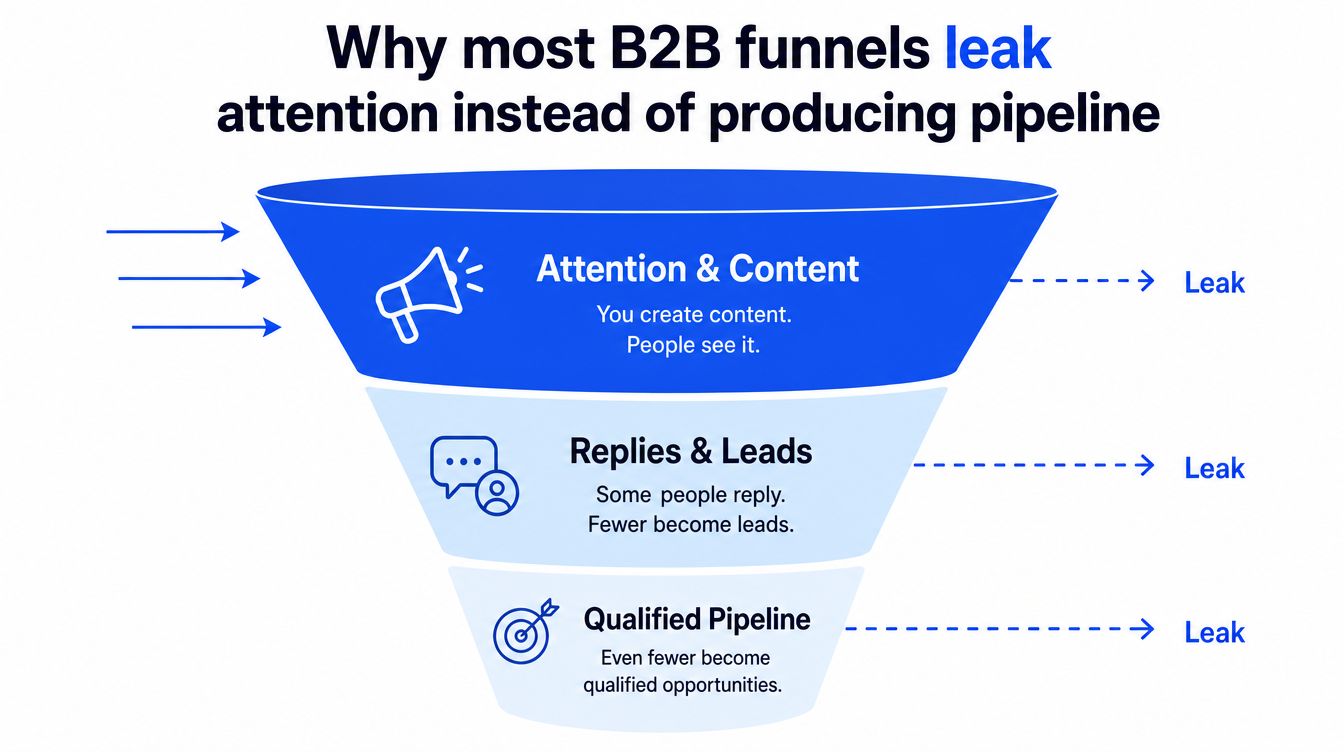
Your funnel isn't short on attention. It's short on qualified movement, and that gap usually shows up after the content gets the click, the form fill, or the first reply. The problem is rarely awareness alone, it's the handoffs, the delay, and the qualification rules that turn interest into a real opportunity.
Most B2B funnels leak before sales ever sees a live opportunity, which is why top-of-funnel volume often flatters the dashboard while pipeline stays flat.
Stage design matters more than raw lead volume, because leakage is usually concentrated at qualification and follow-up, not at impression generation.
Speed and discipline beat broad nurture, since response delay and weak routing can erase intent before a human conversation starts.
SaaS and manufacturing need different funnel shapes, because the buying journey, stakeholder count, and decision criteria are not the same.
For a related diagnosis of why lead flow stalls after the first touch, see GROU's analysis of why your leads aren't converting and how to fix it.
Table of Contents
Why most B2B funnels leak attention instead of producing pipeline
The funnel fills with content readers, ad clicks, and replies, then loses people at the exact handoff where a human should decide whether the lead deserves the next step. In B2B, that leakage is structural, not accidental.
A useful benchmark says only about 2% to 5% of leads become paying customers across B2B industries, and one synthesis puts MQL-to-SQL conversion at just 15% to 21% sales funnel statistics. Another benchmark says B2B funnels lose more than 60% of prospects across the journey, and 79% of leads never convert because they aren't nurtured sales funnel statistics. That's why the job isn't “make more content,” it's “stop letting intent leak away.”
Practical rule: If the dashboard only measures volume, it's hiding the real bottleneck.
The right way to read a B2B marketing funnel is as a sequence of stage exits, not a content calendar. Salesforce frames the path as awareness, consideration, and evaluation before purchase, while Apollo's TOFU, MOFU, and BOFU language gives operators something usable for content, routing, and handoff design B2B marketing funnel. That structure matters because the stage definition tells you when a lead is ready for a sales motion, and when it's still just attention.
If your team is running LinkedIn, email, and inbound together, the connective tissue is usually what's broken. The fix is stage clarity, response speed, and a qualification standard that sales trusts.
The four stages every B2B funnel must engineer
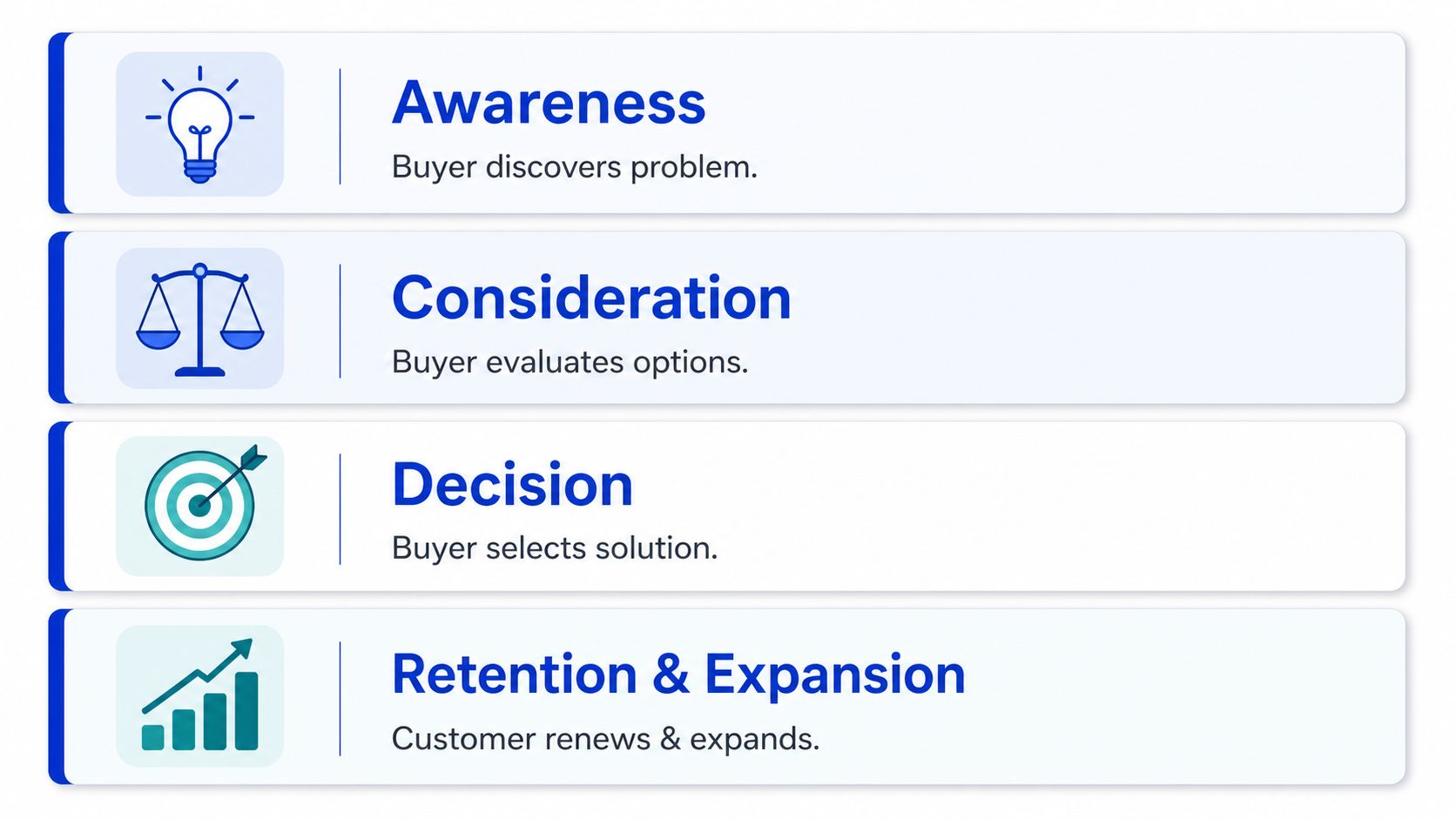
A B2B marketing funnel breaks when stage design is vague. Awareness, consideration, decision, and retention each need a different exit condition, or the system starts counting motion as progress.
Awareness and consideration
The first two stages separate attention from movement. Awareness means the buyer can name the problem, consideration means they are comparing ways to solve it. In practice, that signal may come from a blog post, a founder's LinkedIn post, a webinar, or a reply that shows curiosity without purchase intent.
The handoff rule is direct, the buyer should have enough context to move forward without being pushed. A prospect who downloads content and keeps browsing is not ready for a demo just because they raised a hand. They are ready when the signal shows that the problem, timing, or team structure makes buying plausible.
Decision and retention
The decision stage is usually a chain of evaluation, proposal, and negotiation. That is where many funnel diagrams get too tidy for real sales work. Prospects are checking fit, risk, internal politics, and budget logic at the same time, and each one can stall the deal.
Retention and expansion sit after the close, but they still belong in the funnel system. Onboarding materials, renewal motion, and expansion triggers keep the operating model honest, because a pipeline that closes poorly is still a broken funnel. Marketers who stop at won deals often miss the signal that the buyer journey did not finish.
Practical rule: If a stage does not have a clear exit condition, it is not a stage, it is a label.
Stage definitions matter because measurement depends on them. You cannot improve a stage you have not defined, and you cannot define it if marketing and sales use different language for the same buyer behavior. The strongest funnels make each stage visible enough that the handoff is testable, repeatable, and tied to a real conversation.
Why SaaS and manufacturing funnels cannot share one shape
For teams choosing a single template, the verdict is blunt, don't use one funnel shape for both SaaS and manufacturing. Use one operating system, then configure a different stage map per vertical. If you force one journey model onto both, forecasting gets fuzzy and resource planning starts lying.
SaaS usually runs a 6-stage journey across 90 to 130 days, with 10 to 15 touches, 3 to 5 stakeholders, and proposals in the 5 to 15 page range. Manufacturing usually runs a 7-stage journey across 180 to 240 days, with 20 to 30 touches, 5 to 10 stakeholders, and proposals that often reach 30 to 80+ pages with technical specifications. Those differences change the geometry of the funnel itself.
In SaaS, LinkedIn and email usually carry the motion. In manufacturing, phone matters first, LinkedIn and email support the work, and physical mail can still matter on high-value accounts. The decision criteria also differ, SaaS buyers care more about subscription cost and integration effort, while manufacturing buyers care about capital expenditure, total cost of ownership, warranty terms, and service capability.
For a deeper look at industrial motion, GROU's manufacturing lead generation article shows why the sales motion needs more physical touchpoints and longer evaluation windows.
Dimension | SaaS | Manufacturing |
|---|---|---|
Journey length | 90 to 130 days | 180 to 240 days |
Stage count | 6 stages | 7 stages |
Touchpoints | 10 to 15 | 20 to 30 |
Stakeholders | 3 to 5 | 5 to 10 |
Proposal depth | 5 to 15 pages | 30 to 80+ pages |
Channel emphasis | LinkedIn and email | Phone first, then LinkedIn and email |
Reference use | 1 to 3 customer conversations | Site visits and more intensive validation |
The lesson is operational. SaaS can rotate reps faster, manufacturing needs more sustained attention, and both need different measurement rules. Set SaaS expectations on a plant-floor deal and you'll frustrate everyone, set manufacturing timing on a software deal and you'll leave revenue sitting in the queue.
Mapping tactics and channels to each stage
A working funnel uses one primary channel per stage, plus two supporting channels. Anything else turns into noise. The stack below isn't the only possible one, but it's the one that gives a clean handoff from attention to conversation to close.
Awareness and consideration tools
LinkedIn content and SEO do the heavy lifting at awareness. They create repeated exposure before a prospect has any intent to reply. In consideration, Apollo, Clay, and Sales Navigator are better than generic list building because they let you work from signals, not assumptions.
For planning content around those stages, a useful reference is this b2b content planning checklist, especially if your team keeps publishing without a stage map. It's the kind of resource that makes the calendar serve the funnel instead of the other way around.
Decision and retention tools
Decision-stage orchestration usually lives in Lemlist, Instantly, Smartlead, and HeyReach. HubSpot sits underneath it all, handling routing, qualification rules, lifecycle stages, and the retention handoff. If response routing is slow, the rest of the stack is just decoration.
For a broader system view, GROU's 12 effective B2B lead generation methods piece is useful because it separates channel ideas from actual pipeline motion. That distinction matters more than is commonly admitted.
Practical rule: If a tool doesn't change who gets contacted, when they get contacted, or what happens next, it isn't part of the funnel.
The point of cross-channel orchestration is consistency. A signal picked up in LinkedIn should shape the email, the reply template, and the handoff rule in CRM. If those three systems don't agree, the funnel leaks through inconsistency long before it leaks through lack of traffic.
The KPIs that reveal where your funnel actually leaks
Surface metrics can look healthy while the funnel breaks downstream. A campaign can post strong reply rates, good meeting booking, and still produce weak qualified opportunity flow. That's why stage-level KPIs matter more than dashboard vanity.
The most useful diagnostic ratios are Lead-to-MQL and MQL-to-SQL. Benchmark guidance puts Lead-to-MQL at 25% to 35% and MQL-to-SQL at 25% to 40% B2B sales pipeline metrics. If lead volume is high but MQL conversion is weak, the issue is usually ICP fit, scoring logic, or message-to-intent mismatch.
For demand generation teams, it helps to pair that with a broader KPI structure. TrackingPlan's guide to demand gen tactics is useful when you're deciding which signals deserve a dashboard and which ones should stay in campaign ops. The value is in separating activity from actual qualification.
The manufacturing case from the brief is the clearest warning sign. A team saw an 88% meeting show rate, but qualified opportunity rate was only 34%, far below the expected 55% to 65% band. The surface looked strong, but the funnel was filling with interested people who weren't buying-ready.
That's why disqualification should happen early. If the prospect isn't a decision-maker, doesn't have budget path clarity, or entered through a weak signal, keep them out of the opportunity stage. For operational measurement, the internal standard should be simple, stage metrics first, vanity metrics last.
KPI | What it tells you | What usually breaks when it dips |
|---|---|---|
Lead to MQL | Targeting quality | ICP mismatch, weak scoring |
MQL to SQL | Sales acceptance | Bad qualification, poor context |
Meeting show rate | Intent and scheduling quality | Weak follow-up, poor timing |
Qualified opportunity rate | True pipeline quality | Broad signals, shallow discovery |
Cycle length | Sales friction | Stakeholder drag, unclear next step |
Measurement and attribution across an invisible funnel
A lot of B2B buying happens before a prospect ever raises a hand in a trackable way. Private communities, LinkedIn DMs, dark social, and AI summaries can shape the deal before standard attribution sees anything. Click-based reporting undercounts that journey, especially in long, multi-stakeholder cycles.
The practical answer is to combine first-touch, multi-touch, and closed-deal-back analysis. First-touch shows where attention began, multi-touch shows the path, and closed-deal-back work shows which signals appeared in won accounts. If the signals that fill the top of the funnel never show up in closed deals, the model is misleading.
Lead response time is the hard mechanical lever inside that system. Benchmark guidance recommends responding to web-form leads in under 5 minutes, and CartFlows reports that the odds of contacting a lead drop 100x when you wait 30 minutes instead of 5 sales funnel statistics. That is not a messaging problem, it is a routing and SLA problem.
A strong dashboard should capture source, response time, stage transition, and outcome. If your current view stops at leads and clicks, use build a marketing KPI dashboard to tighten the reporting layer before the team starts arguing about channel quality. HubSpot or another CRM can hold the data, but the system only works if the rules are strict enough to separate noise from qualification.
Multi-touch attribution only works when the inputs are clean, and multi-touch attribution in B2B is only useful if it reflects real stage movement instead of raw activity. If a lead goes dark in public channels but returns through a DM or a referral, the funnel still needs a place to record that influence. Teams that accept partial visibility make better decisions than teams waiting for impossible perfection.
Implementation checklist and optimization playbook
Start by writing a separate funnel map for each vertical you sell into. SaaS gets one stage definition set, manufacturing gets another, and both should live inside the same CRM structure. Then validate every signal against closed-won accounts, not just against theory or activity volume.
Next, set a response-time SLA that the team can hit. Build the routing, enrichment, and owner assignment so inbound replies get a human answer in minutes, not later that day. After that, define qualification queries in Clay so weak-fit accounts are filtered before they enter stage two.
A simple 30-day sequence works well.
Week 1: define stages by vertical and write exit criteria.
Week 2: review closed-won accounts and mark which signals really showed up.
Week 3: build reply routing and qualification prompts.
Week 4: inspect meeting-held rate, qualified opportunity rate, and cycle length in a weekly deep-dive.
For broader pipeline work, GROU builds connected systems around LinkedIn content, lead generation, and outbound, then ties them to qualification rules and reporting. The method is stage-specific, vertical-aware, and built for operators who need pipeline, not just activity.
Audit your meeting-held rate this Friday, then pull the last 10 closed-won accounts and mark which signals they shared. If the signal pattern doesn't match your current routing logic, fix the stage rules before you spend another month adding volume.
GROU helps B2B teams build pipeline systems that connect LinkedIn content, outbound, and qualification into one operating model. If you want to map your funnel by vertical and stop leaking attention between stages, visit Grou and review how the team structures pipeline around fit and speed.
Your funnel isn't short on attention. It's short on qualified movement, and that gap usually shows up after the content gets the click, the form fill, or the first reply. The problem is rarely awareness alone, it's the handoffs, the delay, and the qualification rules that turn interest into a real opportunity.
Most B2B funnels leak before sales ever sees a live opportunity, which is why top-of-funnel volume often flatters the dashboard while pipeline stays flat.
Stage design matters more than raw lead volume, because leakage is usually concentrated at qualification and follow-up, not at impression generation.
Speed and discipline beat broad nurture, since response delay and weak routing can erase intent before a human conversation starts.
SaaS and manufacturing need different funnel shapes, because the buying journey, stakeholder count, and decision criteria are not the same.
For a related diagnosis of why lead flow stalls after the first touch, see GROU's analysis of why your leads aren't converting and how to fix it.
Table of Contents
Why most B2B funnels leak attention instead of producing pipeline
The funnel fills with content readers, ad clicks, and replies, then loses people at the exact handoff where a human should decide whether the lead deserves the next step. In B2B, that leakage is structural, not accidental.
A useful benchmark says only about 2% to 5% of leads become paying customers across B2B industries, and one synthesis puts MQL-to-SQL conversion at just 15% to 21% sales funnel statistics. Another benchmark says B2B funnels lose more than 60% of prospects across the journey, and 79% of leads never convert because they aren't nurtured sales funnel statistics. That's why the job isn't “make more content,” it's “stop letting intent leak away.”
Practical rule: If the dashboard only measures volume, it's hiding the real bottleneck.
The right way to read a B2B marketing funnel is as a sequence of stage exits, not a content calendar. Salesforce frames the path as awareness, consideration, and evaluation before purchase, while Apollo's TOFU, MOFU, and BOFU language gives operators something usable for content, routing, and handoff design B2B marketing funnel. That structure matters because the stage definition tells you when a lead is ready for a sales motion, and when it's still just attention.
If your team is running LinkedIn, email, and inbound together, the connective tissue is usually what's broken. The fix is stage clarity, response speed, and a qualification standard that sales trusts.
The four stages every B2B funnel must engineer
A B2B marketing funnel breaks when stage design is vague. Awareness, consideration, decision, and retention each need a different exit condition, or the system starts counting motion as progress.
Awareness and consideration
The first two stages separate attention from movement. Awareness means the buyer can name the problem, consideration means they are comparing ways to solve it. In practice, that signal may come from a blog post, a founder's LinkedIn post, a webinar, or a reply that shows curiosity without purchase intent.
The handoff rule is direct, the buyer should have enough context to move forward without being pushed. A prospect who downloads content and keeps browsing is not ready for a demo just because they raised a hand. They are ready when the signal shows that the problem, timing, or team structure makes buying plausible.
Decision and retention
The decision stage is usually a chain of evaluation, proposal, and negotiation. That is where many funnel diagrams get too tidy for real sales work. Prospects are checking fit, risk, internal politics, and budget logic at the same time, and each one can stall the deal.
Retention and expansion sit after the close, but they still belong in the funnel system. Onboarding materials, renewal motion, and expansion triggers keep the operating model honest, because a pipeline that closes poorly is still a broken funnel. Marketers who stop at won deals often miss the signal that the buyer journey did not finish.
Practical rule: If a stage does not have a clear exit condition, it is not a stage, it is a label.
Stage definitions matter because measurement depends on them. You cannot improve a stage you have not defined, and you cannot define it if marketing and sales use different language for the same buyer behavior. The strongest funnels make each stage visible enough that the handoff is testable, repeatable, and tied to a real conversation.
Why SaaS and manufacturing funnels cannot share one shape
For teams choosing a single template, the verdict is blunt, don't use one funnel shape for both SaaS and manufacturing. Use one operating system, then configure a different stage map per vertical. If you force one journey model onto both, forecasting gets fuzzy and resource planning starts lying.
SaaS usually runs a 6-stage journey across 90 to 130 days, with 10 to 15 touches, 3 to 5 stakeholders, and proposals in the 5 to 15 page range. Manufacturing usually runs a 7-stage journey across 180 to 240 days, with 20 to 30 touches, 5 to 10 stakeholders, and proposals that often reach 30 to 80+ pages with technical specifications. Those differences change the geometry of the funnel itself.
In SaaS, LinkedIn and email usually carry the motion. In manufacturing, phone matters first, LinkedIn and email support the work, and physical mail can still matter on high-value accounts. The decision criteria also differ, SaaS buyers care more about subscription cost and integration effort, while manufacturing buyers care about capital expenditure, total cost of ownership, warranty terms, and service capability.
For a deeper look at industrial motion, GROU's manufacturing lead generation article shows why the sales motion needs more physical touchpoints and longer evaluation windows.
Dimension | SaaS | Manufacturing |
|---|---|---|
Journey length | 90 to 130 days | 180 to 240 days |
Stage count | 6 stages | 7 stages |
Touchpoints | 10 to 15 | 20 to 30 |
Stakeholders | 3 to 5 | 5 to 10 |
Proposal depth | 5 to 15 pages | 30 to 80+ pages |
Channel emphasis | LinkedIn and email | Phone first, then LinkedIn and email |
Reference use | 1 to 3 customer conversations | Site visits and more intensive validation |
The lesson is operational. SaaS can rotate reps faster, manufacturing needs more sustained attention, and both need different measurement rules. Set SaaS expectations on a plant-floor deal and you'll frustrate everyone, set manufacturing timing on a software deal and you'll leave revenue sitting in the queue.
Mapping tactics and channels to each stage
A working funnel uses one primary channel per stage, plus two supporting channels. Anything else turns into noise. The stack below isn't the only possible one, but it's the one that gives a clean handoff from attention to conversation to close.
Awareness and consideration tools
LinkedIn content and SEO do the heavy lifting at awareness. They create repeated exposure before a prospect has any intent to reply. In consideration, Apollo, Clay, and Sales Navigator are better than generic list building because they let you work from signals, not assumptions.
For planning content around those stages, a useful reference is this b2b content planning checklist, especially if your team keeps publishing without a stage map. It's the kind of resource that makes the calendar serve the funnel instead of the other way around.
Decision and retention tools
Decision-stage orchestration usually lives in Lemlist, Instantly, Smartlead, and HeyReach. HubSpot sits underneath it all, handling routing, qualification rules, lifecycle stages, and the retention handoff. If response routing is slow, the rest of the stack is just decoration.
For a broader system view, GROU's 12 effective B2B lead generation methods piece is useful because it separates channel ideas from actual pipeline motion. That distinction matters more than is commonly admitted.
Practical rule: If a tool doesn't change who gets contacted, when they get contacted, or what happens next, it isn't part of the funnel.
The point of cross-channel orchestration is consistency. A signal picked up in LinkedIn should shape the email, the reply template, and the handoff rule in CRM. If those three systems don't agree, the funnel leaks through inconsistency long before it leaks through lack of traffic.
The KPIs that reveal where your funnel actually leaks
Surface metrics can look healthy while the funnel breaks downstream. A campaign can post strong reply rates, good meeting booking, and still produce weak qualified opportunity flow. That's why stage-level KPIs matter more than dashboard vanity.
The most useful diagnostic ratios are Lead-to-MQL and MQL-to-SQL. Benchmark guidance puts Lead-to-MQL at 25% to 35% and MQL-to-SQL at 25% to 40% B2B sales pipeline metrics. If lead volume is high but MQL conversion is weak, the issue is usually ICP fit, scoring logic, or message-to-intent mismatch.
For demand generation teams, it helps to pair that with a broader KPI structure. TrackingPlan's guide to demand gen tactics is useful when you're deciding which signals deserve a dashboard and which ones should stay in campaign ops. The value is in separating activity from actual qualification.
The manufacturing case from the brief is the clearest warning sign. A team saw an 88% meeting show rate, but qualified opportunity rate was only 34%, far below the expected 55% to 65% band. The surface looked strong, but the funnel was filling with interested people who weren't buying-ready.
That's why disqualification should happen early. If the prospect isn't a decision-maker, doesn't have budget path clarity, or entered through a weak signal, keep them out of the opportunity stage. For operational measurement, the internal standard should be simple, stage metrics first, vanity metrics last.
KPI | What it tells you | What usually breaks when it dips |
|---|---|---|
Lead to MQL | Targeting quality | ICP mismatch, weak scoring |
MQL to SQL | Sales acceptance | Bad qualification, poor context |
Meeting show rate | Intent and scheduling quality | Weak follow-up, poor timing |
Qualified opportunity rate | True pipeline quality | Broad signals, shallow discovery |
Cycle length | Sales friction | Stakeholder drag, unclear next step |
Measurement and attribution across an invisible funnel
A lot of B2B buying happens before a prospect ever raises a hand in a trackable way. Private communities, LinkedIn DMs, dark social, and AI summaries can shape the deal before standard attribution sees anything. Click-based reporting undercounts that journey, especially in long, multi-stakeholder cycles.
The practical answer is to combine first-touch, multi-touch, and closed-deal-back analysis. First-touch shows where attention began, multi-touch shows the path, and closed-deal-back work shows which signals appeared in won accounts. If the signals that fill the top of the funnel never show up in closed deals, the model is misleading.
Lead response time is the hard mechanical lever inside that system. Benchmark guidance recommends responding to web-form leads in under 5 minutes, and CartFlows reports that the odds of contacting a lead drop 100x when you wait 30 minutes instead of 5 sales funnel statistics. That is not a messaging problem, it is a routing and SLA problem.
A strong dashboard should capture source, response time, stage transition, and outcome. If your current view stops at leads and clicks, use build a marketing KPI dashboard to tighten the reporting layer before the team starts arguing about channel quality. HubSpot or another CRM can hold the data, but the system only works if the rules are strict enough to separate noise from qualification.
Multi-touch attribution only works when the inputs are clean, and multi-touch attribution in B2B is only useful if it reflects real stage movement instead of raw activity. If a lead goes dark in public channels but returns through a DM or a referral, the funnel still needs a place to record that influence. Teams that accept partial visibility make better decisions than teams waiting for impossible perfection.
Implementation checklist and optimization playbook
Start by writing a separate funnel map for each vertical you sell into. SaaS gets one stage definition set, manufacturing gets another, and both should live inside the same CRM structure. Then validate every signal against closed-won accounts, not just against theory or activity volume.
Next, set a response-time SLA that the team can hit. Build the routing, enrichment, and owner assignment so inbound replies get a human answer in minutes, not later that day. After that, define qualification queries in Clay so weak-fit accounts are filtered before they enter stage two.
A simple 30-day sequence works well.
Week 1: define stages by vertical and write exit criteria.
Week 2: review closed-won accounts and mark which signals really showed up.
Week 3: build reply routing and qualification prompts.
Week 4: inspect meeting-held rate, qualified opportunity rate, and cycle length in a weekly deep-dive.
For broader pipeline work, GROU builds connected systems around LinkedIn content, lead generation, and outbound, then ties them to qualification rules and reporting. The method is stage-specific, vertical-aware, and built for operators who need pipeline, not just activity.
Audit your meeting-held rate this Friday, then pull the last 10 closed-won accounts and mark which signals they shared. If the signal pattern doesn't match your current routing logic, fix the stage rules before you spend another month adding volume.
GROU helps B2B teams build pipeline systems that connect LinkedIn content, outbound, and qualification into one operating model. If you want to map your funnel by vertical and stop leaking attention between stages, visit Grou and review how the team structures pipeline around fit and speed.
Your funnel isn't short on attention. It's short on qualified movement, and that gap usually shows up after the content gets the click, the form fill, or the first reply. The problem is rarely awareness alone, it's the handoffs, the delay, and the qualification rules that turn interest into a real opportunity.
Most B2B funnels leak before sales ever sees a live opportunity, which is why top-of-funnel volume often flatters the dashboard while pipeline stays flat.
Stage design matters more than raw lead volume, because leakage is usually concentrated at qualification and follow-up, not at impression generation.
Speed and discipline beat broad nurture, since response delay and weak routing can erase intent before a human conversation starts.
SaaS and manufacturing need different funnel shapes, because the buying journey, stakeholder count, and decision criteria are not the same.
For a related diagnosis of why lead flow stalls after the first touch, see GROU's analysis of why your leads aren't converting and how to fix it.
Table of Contents
Why most B2B funnels leak attention instead of producing pipeline
The funnel fills with content readers, ad clicks, and replies, then loses people at the exact handoff where a human should decide whether the lead deserves the next step. In B2B, that leakage is structural, not accidental.
A useful benchmark says only about 2% to 5% of leads become paying customers across B2B industries, and one synthesis puts MQL-to-SQL conversion at just 15% to 21% sales funnel statistics. Another benchmark says B2B funnels lose more than 60% of prospects across the journey, and 79% of leads never convert because they aren't nurtured sales funnel statistics. That's why the job isn't “make more content,” it's “stop letting intent leak away.”
Practical rule: If the dashboard only measures volume, it's hiding the real bottleneck.
The right way to read a B2B marketing funnel is as a sequence of stage exits, not a content calendar. Salesforce frames the path as awareness, consideration, and evaluation before purchase, while Apollo's TOFU, MOFU, and BOFU language gives operators something usable for content, routing, and handoff design B2B marketing funnel. That structure matters because the stage definition tells you when a lead is ready for a sales motion, and when it's still just attention.
If your team is running LinkedIn, email, and inbound together, the connective tissue is usually what's broken. The fix is stage clarity, response speed, and a qualification standard that sales trusts.
The four stages every B2B funnel must engineer
A B2B marketing funnel breaks when stage design is vague. Awareness, consideration, decision, and retention each need a different exit condition, or the system starts counting motion as progress.
Awareness and consideration
The first two stages separate attention from movement. Awareness means the buyer can name the problem, consideration means they are comparing ways to solve it. In practice, that signal may come from a blog post, a founder's LinkedIn post, a webinar, or a reply that shows curiosity without purchase intent.
The handoff rule is direct, the buyer should have enough context to move forward without being pushed. A prospect who downloads content and keeps browsing is not ready for a demo just because they raised a hand. They are ready when the signal shows that the problem, timing, or team structure makes buying plausible.
Decision and retention
The decision stage is usually a chain of evaluation, proposal, and negotiation. That is where many funnel diagrams get too tidy for real sales work. Prospects are checking fit, risk, internal politics, and budget logic at the same time, and each one can stall the deal.
Retention and expansion sit after the close, but they still belong in the funnel system. Onboarding materials, renewal motion, and expansion triggers keep the operating model honest, because a pipeline that closes poorly is still a broken funnel. Marketers who stop at won deals often miss the signal that the buyer journey did not finish.
Practical rule: If a stage does not have a clear exit condition, it is not a stage, it is a label.
Stage definitions matter because measurement depends on them. You cannot improve a stage you have not defined, and you cannot define it if marketing and sales use different language for the same buyer behavior. The strongest funnels make each stage visible enough that the handoff is testable, repeatable, and tied to a real conversation.
Why SaaS and manufacturing funnels cannot share one shape
For teams choosing a single template, the verdict is blunt, don't use one funnel shape for both SaaS and manufacturing. Use one operating system, then configure a different stage map per vertical. If you force one journey model onto both, forecasting gets fuzzy and resource planning starts lying.
SaaS usually runs a 6-stage journey across 90 to 130 days, with 10 to 15 touches, 3 to 5 stakeholders, and proposals in the 5 to 15 page range. Manufacturing usually runs a 7-stage journey across 180 to 240 days, with 20 to 30 touches, 5 to 10 stakeholders, and proposals that often reach 30 to 80+ pages with technical specifications. Those differences change the geometry of the funnel itself.
In SaaS, LinkedIn and email usually carry the motion. In manufacturing, phone matters first, LinkedIn and email support the work, and physical mail can still matter on high-value accounts. The decision criteria also differ, SaaS buyers care more about subscription cost and integration effort, while manufacturing buyers care about capital expenditure, total cost of ownership, warranty terms, and service capability.
For a deeper look at industrial motion, GROU's manufacturing lead generation article shows why the sales motion needs more physical touchpoints and longer evaluation windows.
Dimension | SaaS | Manufacturing |
|---|---|---|
Journey length | 90 to 130 days | 180 to 240 days |
Stage count | 6 stages | 7 stages |
Touchpoints | 10 to 15 | 20 to 30 |
Stakeholders | 3 to 5 | 5 to 10 |
Proposal depth | 5 to 15 pages | 30 to 80+ pages |
Channel emphasis | LinkedIn and email | Phone first, then LinkedIn and email |
Reference use | 1 to 3 customer conversations | Site visits and more intensive validation |
The lesson is operational. SaaS can rotate reps faster, manufacturing needs more sustained attention, and both need different measurement rules. Set SaaS expectations on a plant-floor deal and you'll frustrate everyone, set manufacturing timing on a software deal and you'll leave revenue sitting in the queue.
Mapping tactics and channels to each stage
A working funnel uses one primary channel per stage, plus two supporting channels. Anything else turns into noise. The stack below isn't the only possible one, but it's the one that gives a clean handoff from attention to conversation to close.
Awareness and consideration tools
LinkedIn content and SEO do the heavy lifting at awareness. They create repeated exposure before a prospect has any intent to reply. In consideration, Apollo, Clay, and Sales Navigator are better than generic list building because they let you work from signals, not assumptions.
For planning content around those stages, a useful reference is this b2b content planning checklist, especially if your team keeps publishing without a stage map. It's the kind of resource that makes the calendar serve the funnel instead of the other way around.
Decision and retention tools
Decision-stage orchestration usually lives in Lemlist, Instantly, Smartlead, and HeyReach. HubSpot sits underneath it all, handling routing, qualification rules, lifecycle stages, and the retention handoff. If response routing is slow, the rest of the stack is just decoration.
For a broader system view, GROU's 12 effective B2B lead generation methods piece is useful because it separates channel ideas from actual pipeline motion. That distinction matters more than is commonly admitted.
Practical rule: If a tool doesn't change who gets contacted, when they get contacted, or what happens next, it isn't part of the funnel.
The point of cross-channel orchestration is consistency. A signal picked up in LinkedIn should shape the email, the reply template, and the handoff rule in CRM. If those three systems don't agree, the funnel leaks through inconsistency long before it leaks through lack of traffic.
The KPIs that reveal where your funnel actually leaks
Surface metrics can look healthy while the funnel breaks downstream. A campaign can post strong reply rates, good meeting booking, and still produce weak qualified opportunity flow. That's why stage-level KPIs matter more than dashboard vanity.
The most useful diagnostic ratios are Lead-to-MQL and MQL-to-SQL. Benchmark guidance puts Lead-to-MQL at 25% to 35% and MQL-to-SQL at 25% to 40% B2B sales pipeline metrics. If lead volume is high but MQL conversion is weak, the issue is usually ICP fit, scoring logic, or message-to-intent mismatch.
For demand generation teams, it helps to pair that with a broader KPI structure. TrackingPlan's guide to demand gen tactics is useful when you're deciding which signals deserve a dashboard and which ones should stay in campaign ops. The value is in separating activity from actual qualification.
The manufacturing case from the brief is the clearest warning sign. A team saw an 88% meeting show rate, but qualified opportunity rate was only 34%, far below the expected 55% to 65% band. The surface looked strong, but the funnel was filling with interested people who weren't buying-ready.
That's why disqualification should happen early. If the prospect isn't a decision-maker, doesn't have budget path clarity, or entered through a weak signal, keep them out of the opportunity stage. For operational measurement, the internal standard should be simple, stage metrics first, vanity metrics last.
KPI | What it tells you | What usually breaks when it dips |
|---|---|---|
Lead to MQL | Targeting quality | ICP mismatch, weak scoring |
MQL to SQL | Sales acceptance | Bad qualification, poor context |
Meeting show rate | Intent and scheduling quality | Weak follow-up, poor timing |
Qualified opportunity rate | True pipeline quality | Broad signals, shallow discovery |
Cycle length | Sales friction | Stakeholder drag, unclear next step |
Measurement and attribution across an invisible funnel
A lot of B2B buying happens before a prospect ever raises a hand in a trackable way. Private communities, LinkedIn DMs, dark social, and AI summaries can shape the deal before standard attribution sees anything. Click-based reporting undercounts that journey, especially in long, multi-stakeholder cycles.
The practical answer is to combine first-touch, multi-touch, and closed-deal-back analysis. First-touch shows where attention began, multi-touch shows the path, and closed-deal-back work shows which signals appeared in won accounts. If the signals that fill the top of the funnel never show up in closed deals, the model is misleading.
Lead response time is the hard mechanical lever inside that system. Benchmark guidance recommends responding to web-form leads in under 5 minutes, and CartFlows reports that the odds of contacting a lead drop 100x when you wait 30 minutes instead of 5 sales funnel statistics. That is not a messaging problem, it is a routing and SLA problem.
A strong dashboard should capture source, response time, stage transition, and outcome. If your current view stops at leads and clicks, use build a marketing KPI dashboard to tighten the reporting layer before the team starts arguing about channel quality. HubSpot or another CRM can hold the data, but the system only works if the rules are strict enough to separate noise from qualification.
Multi-touch attribution only works when the inputs are clean, and multi-touch attribution in B2B is only useful if it reflects real stage movement instead of raw activity. If a lead goes dark in public channels but returns through a DM or a referral, the funnel still needs a place to record that influence. Teams that accept partial visibility make better decisions than teams waiting for impossible perfection.
Implementation checklist and optimization playbook
Start by writing a separate funnel map for each vertical you sell into. SaaS gets one stage definition set, manufacturing gets another, and both should live inside the same CRM structure. Then validate every signal against closed-won accounts, not just against theory or activity volume.
Next, set a response-time SLA that the team can hit. Build the routing, enrichment, and owner assignment so inbound replies get a human answer in minutes, not later that day. After that, define qualification queries in Clay so weak-fit accounts are filtered before they enter stage two.
A simple 30-day sequence works well.
Week 1: define stages by vertical and write exit criteria.
Week 2: review closed-won accounts and mark which signals really showed up.
Week 3: build reply routing and qualification prompts.
Week 4: inspect meeting-held rate, qualified opportunity rate, and cycle length in a weekly deep-dive.
For broader pipeline work, GROU builds connected systems around LinkedIn content, lead generation, and outbound, then ties them to qualification rules and reporting. The method is stage-specific, vertical-aware, and built for operators who need pipeline, not just activity.
Audit your meeting-held rate this Friday, then pull the last 10 closed-won accounts and mark which signals they shared. If the signal pattern doesn't match your current routing logic, fix the stage rules before you spend another month adding volume.
GROU helps B2B teams build pipeline systems that connect LinkedIn content, outbound, and qualification into one operating model. If you want to map your funnel by vertical and stop leaking attention between stages, visit Grou and review how the team structures pipeline around fit and speed.
Pipeline OS Newsletter
Build qualified pipeline
Get weekly tactics to generate demand, improve lead quality, and book more meetings.





Trusted by industry leaders
Trusted by industry leaders
Trusted by industry leaders
Ready to build qualified pipeline?
Ready to build qualified pipeline?
Ready to build qualified pipeline?
Book a call to see if we're the right fit, or take the 2-minute quiz to get a clear starting point.
Book a call to see if we're the right fit, or take the 2-minute quiz to get a clear starting point.
Book a call to see if we're the right fit, or take the 2-minute quiz to get a clear starting point.
" height="30.21639343089746px" id="hfGbXmQR2" width="30.216393430897455px"/></svg>)
Copyright © 2026 – All Right Reserved
Company
Resources
Copyright © 2026 – All Right Reserved
Copyright © 2026 – All Right Reserved