›
›
›
›
Best SaaS directories 2026: all 42, cost and wait
Best SaaS directories 2026: all 42, cost and wait
Best SaaS directories 2026: all 42, cost and wait
Best SaaS directories 2026: all 42, cost and wait
Best SaaS directories 2026: all 42, cost and wait
Best SaaS directories 2026: all 42, cost and wait

Author
Aljaz Peklaj

Four of the five biggest software review sites are now owned by the same company. That happened in February and most lists of SaaS directories have not noticed.
It matters because the standard advice, submit everywhere, was already weak and is now actively misleading. Two of the sites on your list share a submission form. One of them takes more than six weeks. One charges $30,000 a year. One will not let you submit at all. We opened all 42 and wrote down what each one actually costs, who approves it, and how long it takes.
TL;DR
G2 announced on 29 January 2026 that it was acquiring Capterra, Software Advice and GetApp from Gartner, and Gartner's own Q1 2026 results confirm the Digital Markets sale closed in February 2026. Capterra now brands itself "Capterra, powered by G2 Digital Markets" and all three acquired sites submit through one shared form, so what used to be four listings is now one relationship with two vendors. Of the 42 directories below, 26 have a genuinely free listing, 6 have no free option at all, and 8 do not publish what they charge. Only 21 publish how long approval takes, and the spread is enormous: SoftwareWorld says 24 to 48 working hours, Software Advice says "It can take over six weeks for submissions to be vetted, profiles written, and the product published on our site." The single most useful fact we found is on AlternativeTo: the free queue runs "at least a few months", and $5 moves you to the front for 1 to 2 business days.
All 42, with what each one costs
Domain Rating by Ahrefs and estimated monthly organic visits from DataForSEO, both collected on 12 August 2026. Everything in the last three columns was read off each directory's own vendor page on the same day. Where a directory does not publish a figure we have written "not published" rather than guessing.
Directory | What it is | DR | Monthly visits | Listing cost | Who approves | Time to live |
|---|---|---|---|---|---|---|
SourceForge | Alternatives and discovery | 92 | 3,775,981 | Free listing, paid tiers quote only | Not published | Not published |
G2 | Review directories | 91 | 2,456,579 | Free to claim | G2 research team | 3-5 business days |
Capterra | Review directories | 91 | 1,960,617 | Free tier, paid lead gen | Digital Markets team | Over six weeks |
Software Advice | Review directories | 87 | 1,033,248 | Free tier, paid lead gen | Digital Markets team | Over six weeks |
Slashdot Software | Alternatives and discovery | 87 | 624,861 | Same as SourceForge | Not published | Not published |
SaaSWorthy | Review directories | 75 | 580,727 | Free tier, paid quote only | SaaSWorthy staff | Not published |
SoftwareSuggest | Review directories | 78 | 464,038 | Free, paid from $4,000/6 months | Not published | Not published |
Product Hunt | Launch platforms | 91 | 429,214 | Free | Community | Daily cycle |
There's An AI For That | AI tool directories | 77 | 398,590 | $49 review fee, refunded if rejected | Staff, manual review | 1 to 2 days |
GetApp | Review directories | 85 | 374,020 | Free tier, paid lead gen | Content team | Not published |
TechnologyAdvice | Review directories | 78 | 356,187 | Free, Enhanced $100/month | Not published | Not published |
GoodFirms | Review directories | 86 | 252,835 | Free, PRO $49/month | GoodFirms research team | Not published |
Software Finder | Review directories | 74 | 251,679 | Free profile, premium paid | Staff review | 3 to 5 business days |
TrustRadius | Review directories | 84 | 251,449 | Free profile, $30,000/product/year paid | Not published | Not published |
SelectHub | Review directories | 74 | 231,277 | Not published | Analyst team | Not published |
SoftwareWorld | Review directories | 73 | 207,322 | Free, Featured $199/month | Research team | 24 to 48 working hours |
AlternativeTo | Alternatives and discovery | 80 | 206,662 | Free, or $5 to skip the queue | Admin review | Months free, 1-2 days paid |
Toolify | AI tool directories | 72 | 205,563 | $99 express | Automated content pipeline | 48 hours |
Serchen | Review directories | 68 | 161,603 | Not published | Not published | Not published |
SaaSHub | Alternatives and discovery | 80 | 134,196 | Free, featured $99/month | Not published | Not published |
Crozdesk | Review directories | 74 | 133,982 | Free listing, paid referrals | Editorial review | Usually within 48 hours |
AppSumo | Deal marketplaces | 83 | 131,456 | Free to apply, revenue share | Partner vetting team | Not published |
Indie Hackers | Launch platforms | 81 | 108,103 | Free | Not published | Not published |
SoftwareReviews | Review directories | 73 | 83,843 | Free tier, paid not published | Info-Tech analysts | Not published |
Peerlist Launchpad | Launch platforms | 77 | 73,994 | Not published | Community and staff picks | Weekly cycle |
Futurepedia | AI tool directories | 72 | 72,335 | $247 or $497, no free tier | Editorial approval | 2 to 7 days |
TopAI.tools | AI tool directories | 64 | 66,381 | $47 or $229, refund if rejected | Editorial team | 24 to 48 hours |
ITQlick | Review directories | 56 | 59,029 | Cannot be bought | ITQlick researchers | Not applicable |
Future Tools | AI tool directories | 69 | 52,628 | Free | Human review, Matt Wolfe | Resubmit after a week |
PeerSpot | Review directories | 74 | 41,820 | Not published | PeerSpot staff | Not published |
Tekpon | Review directories | 72 | 30,937 | $249 one-time, no free tier | Staff, refund if rejected | Not published |
StackShare | Alternatives and discovery | 79 | 30,871 | Free to claim | Automated verification | Minutes to verify |
Startup Stash | Launch platforms | 65 | 28,933 | Not published | Not published | Not published |
BetaList | Launch platforms | 76 | 28,901 | Paid only, no free option | Editorial team | Depends on plan |
CompareCamp | Review directories | 72 | 19,777 | Not published | Not published | Not published |
Uneed | Launch platforms | 75 | 13,928 | Free, or $14.99 to fast-track | Community voting | Months free, 2 weeks paid |
DevHunt | Launch platforms | 62 | 9,622 | Not published | Not published | Not published |
FinancesOnline | Review directories | 87 | 8,780 | Not published | Not published | Not published |
Launching Next | Launch platforms | 53 | 3,285 | Free, $99 to speed up | Editorial | Daily review, no free SLA |
Fazier | Launch platforms | 82 | 1,562 | Free with backlink, paid from $29 | Not published | 30 days free, instant paid |
BetaPage | Launch platforms | 55 | 0 | Free, Pro $49, Premium $99 | Not published | 30 days free, 2 weeks Pro |
Gartner Peer Insights | Review directories | n/a | n/a | Free | Market alignment team | 8-10 business days |
Two rows need a word of explanation. Gartner Peer Insights shows no metrics because the only figures available are for the whole of gartner.com, which is a research firm rather than a directory, and publishing those numbers would flatter it enormously. Slashdot shares its data and its submission form with SourceForge, because both are Slashdot Media and the Slashdot submit link hands off to SourceForge's form.
Four of the five biggest are now one company
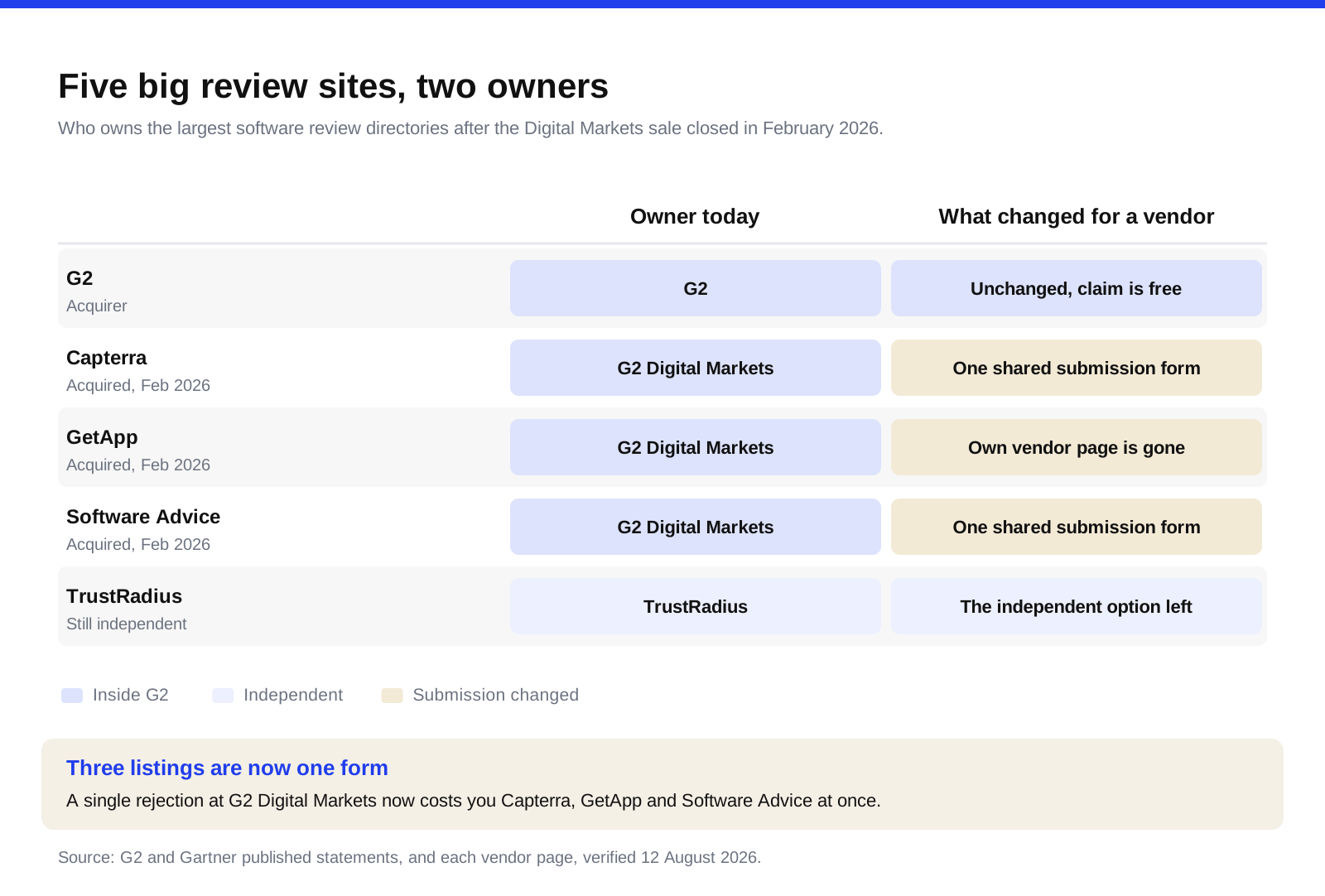
The deal is done, not pending. G2 announced the acquisition of Capterra, Software Advice and GetApp on 29 January 2026. Gartner's first quarter results record the sale of the Digital Markets operation in February 2026 with a gain of $6.1 million, without naming the buyer. Between the two filings the picture is unambiguous.
You can see it on the vendor pages. Capterra's own vendor page now reads "Capterra, powered by G2 Digital Markets". The submission flow for Capterra, GetApp and Software Advice all resolve to the same application at app.g2digitalmarkets.com. GetApp no longer has a vendor landing page of its own.
Which changes the arithmetic of a submission afternoon. Submitting to Capterra, GetApp and Software Advice is not three tasks any more, it is one form with three outputs. That is genuinely good news, and it also means a single rejection costs you three listings rather than one.
TrustRadius is the significant independent left. It is the only one of the large review platforms not now inside G2, which is worth knowing if you care about not concentrating your entire review presence with one owner. Gartner kept Peer Insights, which was never part of the Digital Markets sale.
And it explains a question we kept seeing. People are searching for whether any independent software review sites are left after the G2 deal. The answer is yes, but the list is shorter than it was in January. Our comparison of G2, Capterra and TrustRadius covers what each one is actually selling you.
What a listing really costs
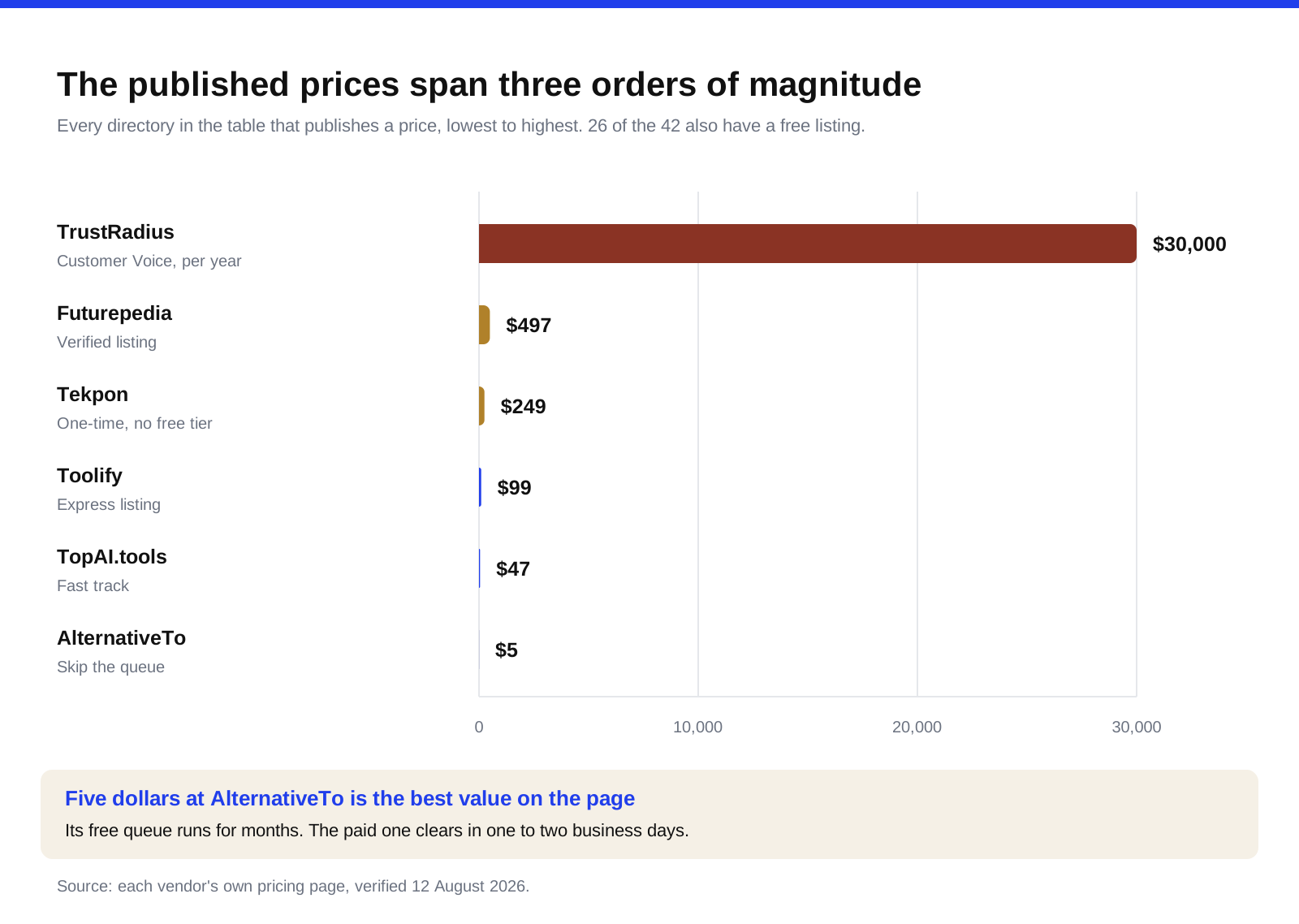
Free is still the norm, but it is not the majority you would assume. 26 of the 42 have a free listing you can actually use. Six have no free option whatsoever: BetaList states "All submissions are paid. There is no free submission option", Tekpon has moved to "$249 One-Time Fee" with no free tier, and Futurepedia starts at $247 with no free path at all.
The published prices span three orders of magnitude. AlternativeTo will jump your queue for $5. TopAI.tools is $47. Toolify is $99. Tekpon is $249 one-time. Futurepedia's verified listing is $497. TrustRadius publishes a Customer Voice Package at $30,000 per product per year. All of those buy different things, and only the last one is a review programme rather than a listing.
Eight will not tell you what they charge. SelectHub, Serchen, PeerSpot, Peerlist, Startup Stash, CompareCamp, DevHunt and FinancesOnline publish no price and no pricing model on their vendor pages. That is not automatically sinister, but it does mean you cannot plan a budget before making contact, and several of them ask for your marketing budget on the submission form.
Watch for the ones that charge in links rather than money. Fazier's free tier states "A backlink to our site is required (on your homepage or footer)". That is a reciprocal link in exchange for a listing, which is worth reading against Google's published position on link exchanges before you agree to it. Our B2B directory listing checklist covers exactly that question.
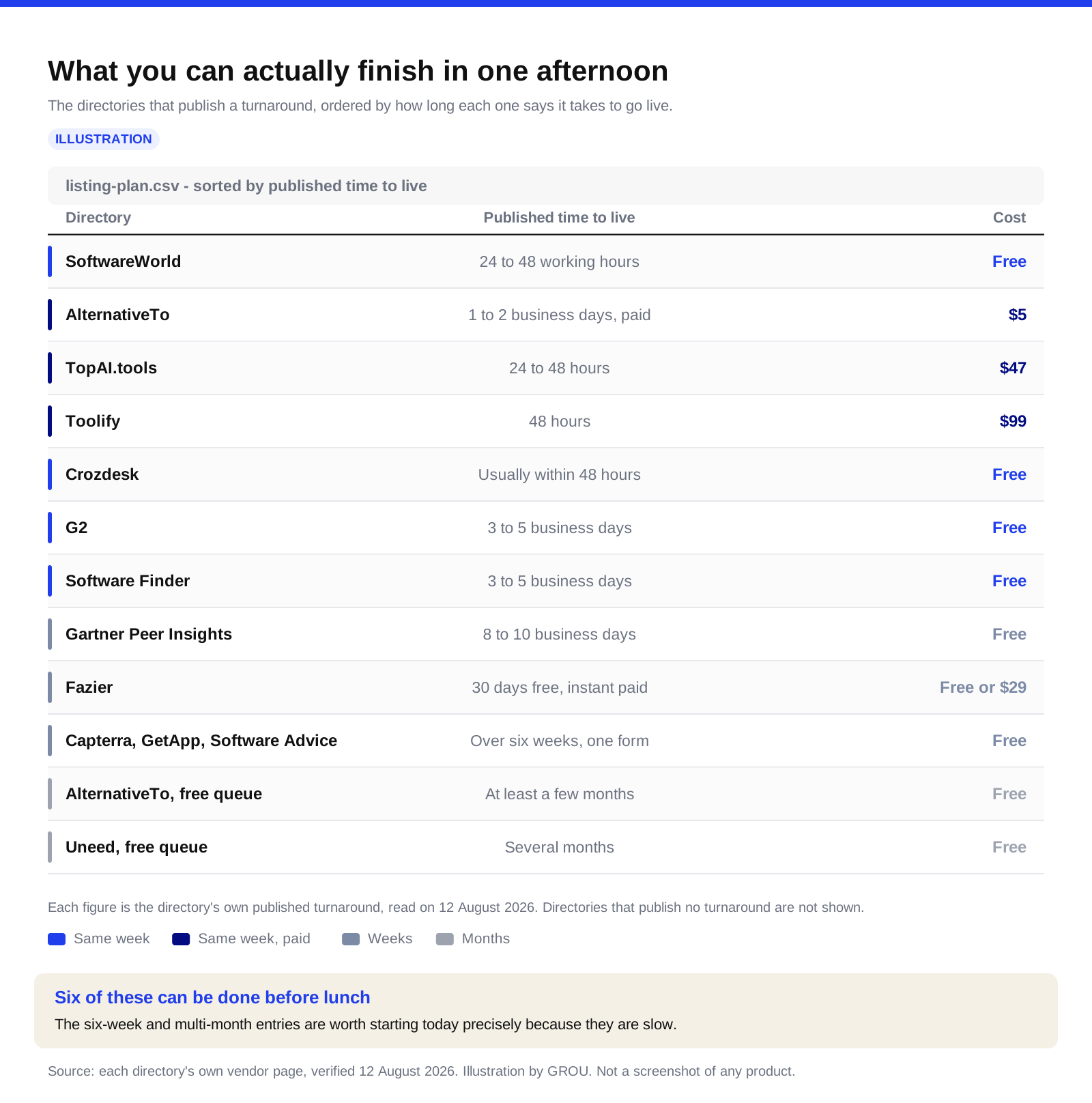
The free ones worth an afternoon
G2, and expect a wait rather than a fee. Claiming is free and the research team verifies in three to five business days. Note the eligibility gate: "G2 does not accept business-to-consumer (B2C) products or products that are currently in the alpha or beta stage of development", so pre-launch products are out. Our guide to getting listed on G2 covers the submission itself.
The G2 Digital Markets form, once, for three listings. Capterra, GetApp and Software Advice. Budget six weeks and understand that the profile copy is written by them rather than by you. Our Capterra listing guide still applies to the mechanics.
SourceForge, which is two listings for one submission. DR 92 and 3.8 million monthly visits, the largest audience in this table, and a free listing tier. Commercial SaaS is welcome; you do not need any open source code. The same form covers Slashdot.
SoftwareWorld, because it is the fastest. "It is completely free to get listed on SoftwareWorld", and approval takes 24 to 48 working hours. Nothing else in the table publishes a turnaround that short.
Product Hunt, on a personal account. Free, community ranked, and the two rules that catch people are that "Company accounts are prohibited" and that you cannot ask directly for upvotes.
Future Tools, if you are an AI product and want the credibility. Free, and "The tools that are submitted are manually reviewed, by a human (not AI)". More than three quarters of submissions are rejected, and paid placements "never influence the Top 20, reviews, or Matt's Picks", which is a rarer separation than it should be.
And AlternativeTo for five dollars. The free queue is honestly described as "at least a few months". Five dollars moves it to one or two business days. It is the best value on this entire page.
The ones to skip, and why
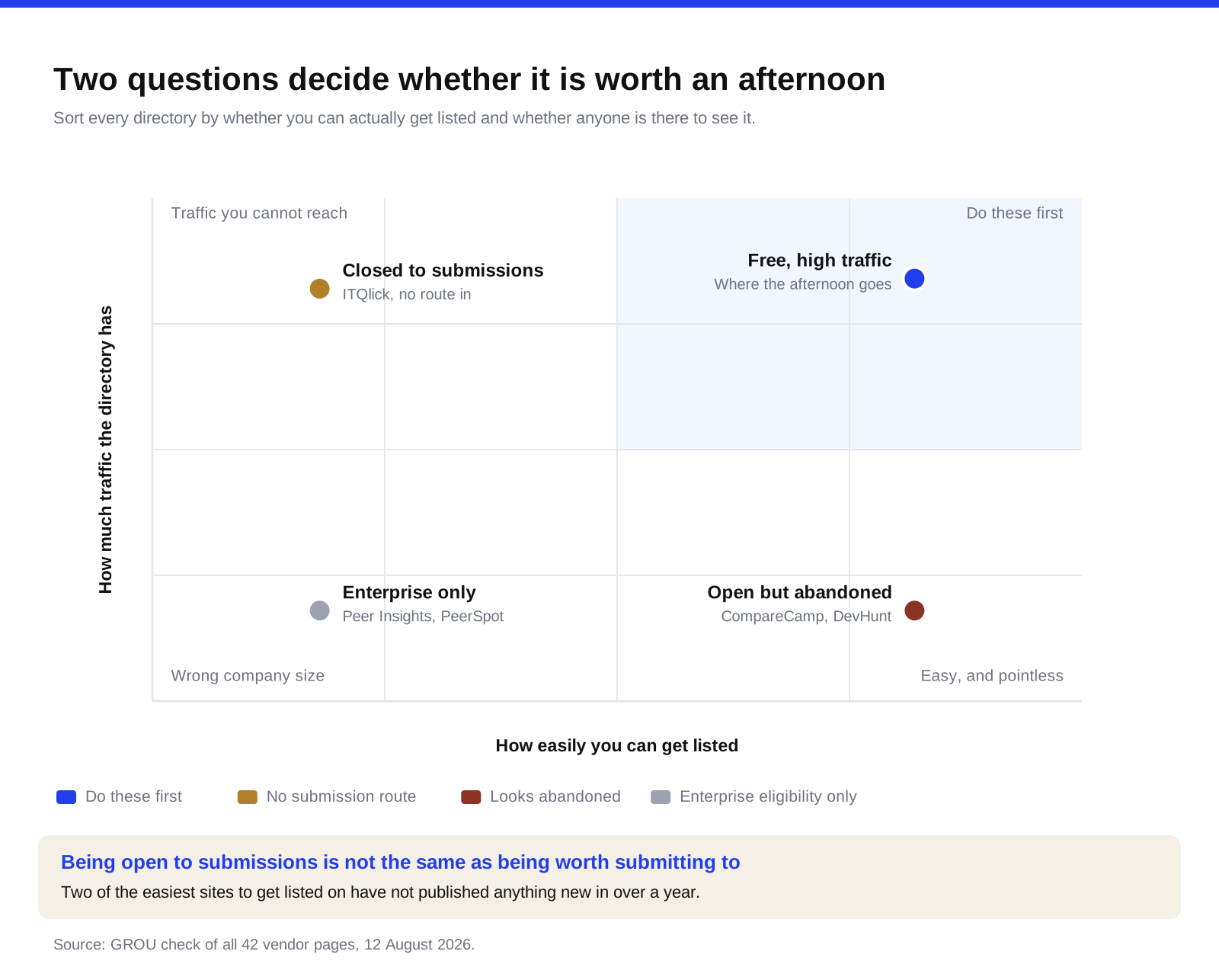
ITQlick, because you cannot get in. There is no submission route. Listings are compiled by their own researchers, and the site states "We currently don't offer CPA or PPC advertiser programs." The only lever you have is publishing clear pricing on your own site, because that is what their scoring reads.
Gartner Peer Insights and PeerSpot, unless you sell to enterprises. Peer Insights requires that "The Vendor must sell to mid to large-size enterprise clients" and that your product maps to an existing Magic Quadrant or Market Guide. PeerSpot requires at least 50 employees and ten enterprise customers. Both are excellent and both will reject most SMB SaaS.
CompareCamp, which looks abandoned. The footer copyright line still reads 2020 and the most recent content we could find is from January 2025.
BetaPage, because it no longer exists. betapage.co now redirects to PitchWall. The listing opportunity is real, the brand in every other article on this subject is not.
DevHunt, on the evidence of its own sitemap. Live, free, and carrying obvious junk entries, with launches heavily concentrated in 2023 and 2024. Treat it as a cheap backlink rather than an audience.
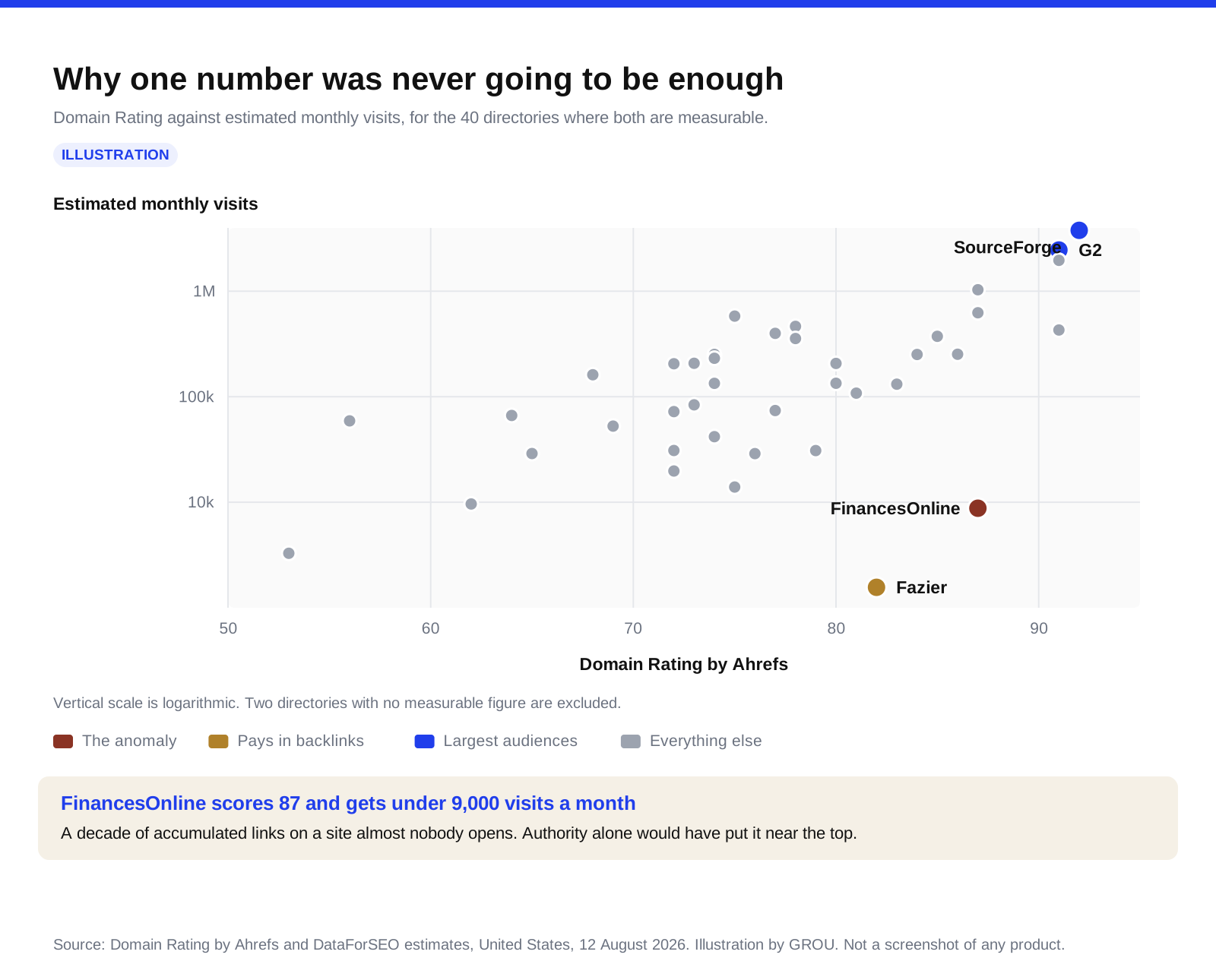
And the one that is not a mistake but looks like one. FinancesOnline has a Domain Rating of 87, higher than TrustRadius or GoodFirms, and 8,780 monthly visits. That is a decade of accumulated links attached to a site almost nobody uses any more. It is the clearest argument on this page for why we published two numbers instead of one, and why choosing directories on authority alone will waste your afternoon.
How we checked this
Every row was opened. On 12 August 2026 we visited the vendor page, submission page or help centre of all 42 directories and recorded the listing cost, the approving party and the published turnaround. Where a directory does not publish something, the table says "not published" rather than an estimate.
Domain Rating by Ahrefs, collected through Ahrefs' public domain rating endpoint on 12 August 2026. Estimated monthly organic visits are from DataForSEO's bulk traffic estimation, United States, on the same date. Both are third party estimates rather than measured traffic, and they disagree with each other in places, which is the point of showing both.
We removed things that are not SaaS directories. Earlier versions of this page included LinkedIn, Crunchbase, Wellfound and Clutch. You cannot create a product listing on any of them and no software buyer browses them to shortlist software, so they have gone. Integration marketplaces like AppExchange and the HubSpot marketplace are genuinely valuable and are also a different job, so they are not in this table either.
Nothing here is sponsored. No directory paid to be included, excluded or ranked, and we hold no affiliate relationship with any of them.
What we do not publish here
A single recommended shortlist for every reader. A pre-launch product and a Series B enterprise platform have almost no overlap in this table, which is why the cost and eligibility columns exist.
Any estimate of what a listing is worth in leads. Ours come from a specific set of programmes in specific categories and would mislead anyone applying them elsewhere.
Prices for the eight that do not publish them. We asked the pages, the pages did not say, and inventing a number would be worse than the gap.
A judgement on which directories Google considers low quality. Google names the category of link and not the sites, and naming sites on that basis would be an inference dressed as a finding.
A submission service. Several sites in this space sell bulk submission to hundreds of directories. If the list is worth working, it is worth working by hand.
FAQ
How many SaaS directories are actually worth listing on?
Fewer than the 150 and 260 entry lists suggest. Of the 42 we checked, roughly a dozen justify an afternoon for most SaaS companies: G2, the shared Capterra and GetApp and Software Advice submission, SourceForge, which also covers Slashdot, AlternativeTo, Product Hunt, SoftwareWorld, GoodFirms and SaaSHub, plus the AI directories if you are an AI product.
Does G2 own Capterra now?
Yes. G2 announced the acquisition of Capterra, Software Advice and GetApp from Gartner on 29 January 2026, and Gartner's Q1 2026 results confirm the Digital Markets sale closed in February 2026. Capterra's vendor page now reads "Capterra, powered by G2 Digital Markets" and all three submit through one form. Gartner kept Peer Insights.
How long does it take to get listed on a SaaS directory?
It varies more than anything else in this table. SoftwareWorld publishes 24 to 48 working hours. G2 says three to five business days. Gartner Peer Insights says eight to ten. Software Advice says "It can take over six weeks". AlternativeTo's free queue is "at least a few months" unless you pay $5.
Are SaaS directory listings free?
26 of the 42 have a genuinely free listing. Six do not offer one at all, including BetaList, Tekpon and Futurepedia. Eight publish no price whatsoever. And watch for Fazier, whose free tier requires a reciprocal backlink from your homepage or footer, which is a cost in a different currency.
Which SaaS directory has the most traffic?
Of the ones we measured, SourceForge at roughly 3.8 million estimated monthly organic visits in the United States, then G2 at 2.5 million and Capterra at 2.0 million. Estimated figures from DataForSEO, August 2026. Note that traffic and authority do not track each other: FinancesOnline has a Domain Rating of 87 and under 9,000 monthly visits.
Can I pay to rank higher in a SaaS directory?
On several, yes, and they say so. SoftwareWorld sells "Top placement in category listings (within the top 5 profiles)". SaaSWorthy sells sponsored badges and first placement. SoftwareSuggest and SelectHub run pay-per-lead programmes. Future Tools is the clearest counter-example, stating that placements never influence its editorial rankings.
Bottom line
Start with the consolidation, because it changes what the work is. Capterra, GetApp and Software Advice are now one submission through G2 Digital Markets, so the old advice to hit all four of the big review sites has become two relationships rather than four. Do G2 and the Digital Markets form, accept that the second one takes six weeks, and add TrustRadius if you want a review presence that is not owned by G2. Then spend an hour on the free listings with real audiences: SourceForge, which also gets you Slashdot, SoftwareWorld for the 48 hour turnaround, Product Hunt from a personal account, and AlternativeTo with the five dollars paid, because the free queue there runs into months. After that, stop. The remaining entries in this table are either niche, unpriced, closed to submissions, or quietly abandoned, and the honest reason we listed all 42 is so you can see which is which rather than working through a list of 260 that nobody checked.
Want the pipeline built rather than the profiles filled in? Book a call with GROU. We run lead generation and outbound inside B2B revenue engines across verticals.
We are GROU, a B2B pipeline agency that runs lead generation, outbound, and LinkedIn content for clients across manufacturing, fintech, iGaming, software, and professional services. Every listing cost, approver and turnaround in this article was read from the directory's own vendor pages on 12 August 2026. Domain Rating by Ahrefs. Estimated monthly organic visits from DataForSEO, United States, August 2026. No directory paid for inclusion or placement, and we hold no affiliate relationship with any of them. Directory terms change often, so check before you submit.
Four of the five biggest software review sites are now owned by the same company. That happened in February and most lists of SaaS directories have not noticed.
It matters because the standard advice, submit everywhere, was already weak and is now actively misleading. Two of the sites on your list share a submission form. One of them takes more than six weeks. One charges $30,000 a year. One will not let you submit at all. We opened all 42 and wrote down what each one actually costs, who approves it, and how long it takes.
TL;DR
G2 announced on 29 January 2026 that it was acquiring Capterra, Software Advice and GetApp from Gartner, and Gartner's own Q1 2026 results confirm the Digital Markets sale closed in February 2026. Capterra now brands itself "Capterra, powered by G2 Digital Markets" and all three acquired sites submit through one shared form, so what used to be four listings is now one relationship with two vendors. Of the 42 directories below, 26 have a genuinely free listing, 6 have no free option at all, and 8 do not publish what they charge. Only 21 publish how long approval takes, and the spread is enormous: SoftwareWorld says 24 to 48 working hours, Software Advice says "It can take over six weeks for submissions to be vetted, profiles written, and the product published on our site." The single most useful fact we found is on AlternativeTo: the free queue runs "at least a few months", and $5 moves you to the front for 1 to 2 business days.
All 42, with what each one costs
Domain Rating by Ahrefs and estimated monthly organic visits from DataForSEO, both collected on 12 August 2026. Everything in the last three columns was read off each directory's own vendor page on the same day. Where a directory does not publish a figure we have written "not published" rather than guessing.
Directory | What it is | DR | Monthly visits | Listing cost | Who approves | Time to live |
|---|---|---|---|---|---|---|
SourceForge | Alternatives and discovery | 92 | 3,775,981 | Free listing, paid tiers quote only | Not published | Not published |
G2 | Review directories | 91 | 2,456,579 | Free to claim | G2 research team | 3-5 business days |
Capterra | Review directories | 91 | 1,960,617 | Free tier, paid lead gen | Digital Markets team | Over six weeks |
Software Advice | Review directories | 87 | 1,033,248 | Free tier, paid lead gen | Digital Markets team | Over six weeks |
Slashdot Software | Alternatives and discovery | 87 | 624,861 | Same as SourceForge | Not published | Not published |
SaaSWorthy | Review directories | 75 | 580,727 | Free tier, paid quote only | SaaSWorthy staff | Not published |
SoftwareSuggest | Review directories | 78 | 464,038 | Free, paid from $4,000/6 months | Not published | Not published |
Product Hunt | Launch platforms | 91 | 429,214 | Free | Community | Daily cycle |
There's An AI For That | AI tool directories | 77 | 398,590 | $49 review fee, refunded if rejected | Staff, manual review | 1 to 2 days |
GetApp | Review directories | 85 | 374,020 | Free tier, paid lead gen | Content team | Not published |
TechnologyAdvice | Review directories | 78 | 356,187 | Free, Enhanced $100/month | Not published | Not published |
GoodFirms | Review directories | 86 | 252,835 | Free, PRO $49/month | GoodFirms research team | Not published |
Software Finder | Review directories | 74 | 251,679 | Free profile, premium paid | Staff review | 3 to 5 business days |
TrustRadius | Review directories | 84 | 251,449 | Free profile, $30,000/product/year paid | Not published | Not published |
SelectHub | Review directories | 74 | 231,277 | Not published | Analyst team | Not published |
SoftwareWorld | Review directories | 73 | 207,322 | Free, Featured $199/month | Research team | 24 to 48 working hours |
AlternativeTo | Alternatives and discovery | 80 | 206,662 | Free, or $5 to skip the queue | Admin review | Months free, 1-2 days paid |
Toolify | AI tool directories | 72 | 205,563 | $99 express | Automated content pipeline | 48 hours |
Serchen | Review directories | 68 | 161,603 | Not published | Not published | Not published |
SaaSHub | Alternatives and discovery | 80 | 134,196 | Free, featured $99/month | Not published | Not published |
Crozdesk | Review directories | 74 | 133,982 | Free listing, paid referrals | Editorial review | Usually within 48 hours |
AppSumo | Deal marketplaces | 83 | 131,456 | Free to apply, revenue share | Partner vetting team | Not published |
Indie Hackers | Launch platforms | 81 | 108,103 | Free | Not published | Not published |
SoftwareReviews | Review directories | 73 | 83,843 | Free tier, paid not published | Info-Tech analysts | Not published |
Peerlist Launchpad | Launch platforms | 77 | 73,994 | Not published | Community and staff picks | Weekly cycle |
Futurepedia | AI tool directories | 72 | 72,335 | $247 or $497, no free tier | Editorial approval | 2 to 7 days |
TopAI.tools | AI tool directories | 64 | 66,381 | $47 or $229, refund if rejected | Editorial team | 24 to 48 hours |
ITQlick | Review directories | 56 | 59,029 | Cannot be bought | ITQlick researchers | Not applicable |
Future Tools | AI tool directories | 69 | 52,628 | Free | Human review, Matt Wolfe | Resubmit after a week |
PeerSpot | Review directories | 74 | 41,820 | Not published | PeerSpot staff | Not published |
Tekpon | Review directories | 72 | 30,937 | $249 one-time, no free tier | Staff, refund if rejected | Not published |
StackShare | Alternatives and discovery | 79 | 30,871 | Free to claim | Automated verification | Minutes to verify |
Startup Stash | Launch platforms | 65 | 28,933 | Not published | Not published | Not published |
BetaList | Launch platforms | 76 | 28,901 | Paid only, no free option | Editorial team | Depends on plan |
CompareCamp | Review directories | 72 | 19,777 | Not published | Not published | Not published |
Uneed | Launch platforms | 75 | 13,928 | Free, or $14.99 to fast-track | Community voting | Months free, 2 weeks paid |
DevHunt | Launch platforms | 62 | 9,622 | Not published | Not published | Not published |
FinancesOnline | Review directories | 87 | 8,780 | Not published | Not published | Not published |
Launching Next | Launch platforms | 53 | 3,285 | Free, $99 to speed up | Editorial | Daily review, no free SLA |
Fazier | Launch platforms | 82 | 1,562 | Free with backlink, paid from $29 | Not published | 30 days free, instant paid |
BetaPage | Launch platforms | 55 | 0 | Free, Pro $49, Premium $99 | Not published | 30 days free, 2 weeks Pro |
Gartner Peer Insights | Review directories | n/a | n/a | Free | Market alignment team | 8-10 business days |
Two rows need a word of explanation. Gartner Peer Insights shows no metrics because the only figures available are for the whole of gartner.com, which is a research firm rather than a directory, and publishing those numbers would flatter it enormously. Slashdot shares its data and its submission form with SourceForge, because both are Slashdot Media and the Slashdot submit link hands off to SourceForge's form.
Four of the five biggest are now one company
The deal is done, not pending. G2 announced the acquisition of Capterra, Software Advice and GetApp on 29 January 2026. Gartner's first quarter results record the sale of the Digital Markets operation in February 2026 with a gain of $6.1 million, without naming the buyer. Between the two filings the picture is unambiguous.
You can see it on the vendor pages. Capterra's own vendor page now reads "Capterra, powered by G2 Digital Markets". The submission flow for Capterra, GetApp and Software Advice all resolve to the same application at app.g2digitalmarkets.com. GetApp no longer has a vendor landing page of its own.
Which changes the arithmetic of a submission afternoon. Submitting to Capterra, GetApp and Software Advice is not three tasks any more, it is one form with three outputs. That is genuinely good news, and it also means a single rejection costs you three listings rather than one.
TrustRadius is the significant independent left. It is the only one of the large review platforms not now inside G2, which is worth knowing if you care about not concentrating your entire review presence with one owner. Gartner kept Peer Insights, which was never part of the Digital Markets sale.
And it explains a question we kept seeing. People are searching for whether any independent software review sites are left after the G2 deal. The answer is yes, but the list is shorter than it was in January. Our comparison of G2, Capterra and TrustRadius covers what each one is actually selling you.
What a listing really costs
Free is still the norm, but it is not the majority you would assume. 26 of the 42 have a free listing you can actually use. Six have no free option whatsoever: BetaList states "All submissions are paid. There is no free submission option", Tekpon has moved to "$249 One-Time Fee" with no free tier, and Futurepedia starts at $247 with no free path at all.
The published prices span three orders of magnitude. AlternativeTo will jump your queue for $5. TopAI.tools is $47. Toolify is $99. Tekpon is $249 one-time. Futurepedia's verified listing is $497. TrustRadius publishes a Customer Voice Package at $30,000 per product per year. All of those buy different things, and only the last one is a review programme rather than a listing.
Eight will not tell you what they charge. SelectHub, Serchen, PeerSpot, Peerlist, Startup Stash, CompareCamp, DevHunt and FinancesOnline publish no price and no pricing model on their vendor pages. That is not automatically sinister, but it does mean you cannot plan a budget before making contact, and several of them ask for your marketing budget on the submission form.
Watch for the ones that charge in links rather than money. Fazier's free tier states "A backlink to our site is required (on your homepage or footer)". That is a reciprocal link in exchange for a listing, which is worth reading against Google's published position on link exchanges before you agree to it. Our B2B directory listing checklist covers exactly that question.
The free ones worth an afternoon
G2, and expect a wait rather than a fee. Claiming is free and the research team verifies in three to five business days. Note the eligibility gate: "G2 does not accept business-to-consumer (B2C) products or products that are currently in the alpha or beta stage of development", so pre-launch products are out. Our guide to getting listed on G2 covers the submission itself.
The G2 Digital Markets form, once, for three listings. Capterra, GetApp and Software Advice. Budget six weeks and understand that the profile copy is written by them rather than by you. Our Capterra listing guide still applies to the mechanics.
SourceForge, which is two listings for one submission. DR 92 and 3.8 million monthly visits, the largest audience in this table, and a free listing tier. Commercial SaaS is welcome; you do not need any open source code. The same form covers Slashdot.
SoftwareWorld, because it is the fastest. "It is completely free to get listed on SoftwareWorld", and approval takes 24 to 48 working hours. Nothing else in the table publishes a turnaround that short.
Product Hunt, on a personal account. Free, community ranked, and the two rules that catch people are that "Company accounts are prohibited" and that you cannot ask directly for upvotes.
Future Tools, if you are an AI product and want the credibility. Free, and "The tools that are submitted are manually reviewed, by a human (not AI)". More than three quarters of submissions are rejected, and paid placements "never influence the Top 20, reviews, or Matt's Picks", which is a rarer separation than it should be.
And AlternativeTo for five dollars. The free queue is honestly described as "at least a few months". Five dollars moves it to one or two business days. It is the best value on this entire page.
The ones to skip, and why
ITQlick, because you cannot get in. There is no submission route. Listings are compiled by their own researchers, and the site states "We currently don't offer CPA or PPC advertiser programs." The only lever you have is publishing clear pricing on your own site, because that is what their scoring reads.
Gartner Peer Insights and PeerSpot, unless you sell to enterprises. Peer Insights requires that "The Vendor must sell to mid to large-size enterprise clients" and that your product maps to an existing Magic Quadrant or Market Guide. PeerSpot requires at least 50 employees and ten enterprise customers. Both are excellent and both will reject most SMB SaaS.
CompareCamp, which looks abandoned. The footer copyright line still reads 2020 and the most recent content we could find is from January 2025.
BetaPage, because it no longer exists. betapage.co now redirects to PitchWall. The listing opportunity is real, the brand in every other article on this subject is not.
DevHunt, on the evidence of its own sitemap. Live, free, and carrying obvious junk entries, with launches heavily concentrated in 2023 and 2024. Treat it as a cheap backlink rather than an audience.
And the one that is not a mistake but looks like one. FinancesOnline has a Domain Rating of 87, higher than TrustRadius or GoodFirms, and 8,780 monthly visits. That is a decade of accumulated links attached to a site almost nobody uses any more. It is the clearest argument on this page for why we published two numbers instead of one, and why choosing directories on authority alone will waste your afternoon.
How we checked this
Every row was opened. On 12 August 2026 we visited the vendor page, submission page or help centre of all 42 directories and recorded the listing cost, the approving party and the published turnaround. Where a directory does not publish something, the table says "not published" rather than an estimate.
Domain Rating by Ahrefs, collected through Ahrefs' public domain rating endpoint on 12 August 2026. Estimated monthly organic visits are from DataForSEO's bulk traffic estimation, United States, on the same date. Both are third party estimates rather than measured traffic, and they disagree with each other in places, which is the point of showing both.
We removed things that are not SaaS directories. Earlier versions of this page included LinkedIn, Crunchbase, Wellfound and Clutch. You cannot create a product listing on any of them and no software buyer browses them to shortlist software, so they have gone. Integration marketplaces like AppExchange and the HubSpot marketplace are genuinely valuable and are also a different job, so they are not in this table either.
Nothing here is sponsored. No directory paid to be included, excluded or ranked, and we hold no affiliate relationship with any of them.
What we do not publish here
A single recommended shortlist for every reader. A pre-launch product and a Series B enterprise platform have almost no overlap in this table, which is why the cost and eligibility columns exist.
Any estimate of what a listing is worth in leads. Ours come from a specific set of programmes in specific categories and would mislead anyone applying them elsewhere.
Prices for the eight that do not publish them. We asked the pages, the pages did not say, and inventing a number would be worse than the gap.
A judgement on which directories Google considers low quality. Google names the category of link and not the sites, and naming sites on that basis would be an inference dressed as a finding.
A submission service. Several sites in this space sell bulk submission to hundreds of directories. If the list is worth working, it is worth working by hand.
FAQ
How many SaaS directories are actually worth listing on?
Fewer than the 150 and 260 entry lists suggest. Of the 42 we checked, roughly a dozen justify an afternoon for most SaaS companies: G2, the shared Capterra and GetApp and Software Advice submission, SourceForge, which also covers Slashdot, AlternativeTo, Product Hunt, SoftwareWorld, GoodFirms and SaaSHub, plus the AI directories if you are an AI product.
Does G2 own Capterra now?
Yes. G2 announced the acquisition of Capterra, Software Advice and GetApp from Gartner on 29 January 2026, and Gartner's Q1 2026 results confirm the Digital Markets sale closed in February 2026. Capterra's vendor page now reads "Capterra, powered by G2 Digital Markets" and all three submit through one form. Gartner kept Peer Insights.
How long does it take to get listed on a SaaS directory?
It varies more than anything else in this table. SoftwareWorld publishes 24 to 48 working hours. G2 says three to five business days. Gartner Peer Insights says eight to ten. Software Advice says "It can take over six weeks". AlternativeTo's free queue is "at least a few months" unless you pay $5.
Are SaaS directory listings free?
26 of the 42 have a genuinely free listing. Six do not offer one at all, including BetaList, Tekpon and Futurepedia. Eight publish no price whatsoever. And watch for Fazier, whose free tier requires a reciprocal backlink from your homepage or footer, which is a cost in a different currency.
Which SaaS directory has the most traffic?
Of the ones we measured, SourceForge at roughly 3.8 million estimated monthly organic visits in the United States, then G2 at 2.5 million and Capterra at 2.0 million. Estimated figures from DataForSEO, August 2026. Note that traffic and authority do not track each other: FinancesOnline has a Domain Rating of 87 and under 9,000 monthly visits.
Can I pay to rank higher in a SaaS directory?
On several, yes, and they say so. SoftwareWorld sells "Top placement in category listings (within the top 5 profiles)". SaaSWorthy sells sponsored badges and first placement. SoftwareSuggest and SelectHub run pay-per-lead programmes. Future Tools is the clearest counter-example, stating that placements never influence its editorial rankings.
Bottom line
Start with the consolidation, because it changes what the work is. Capterra, GetApp and Software Advice are now one submission through G2 Digital Markets, so the old advice to hit all four of the big review sites has become two relationships rather than four. Do G2 and the Digital Markets form, accept that the second one takes six weeks, and add TrustRadius if you want a review presence that is not owned by G2. Then spend an hour on the free listings with real audiences: SourceForge, which also gets you Slashdot, SoftwareWorld for the 48 hour turnaround, Product Hunt from a personal account, and AlternativeTo with the five dollars paid, because the free queue there runs into months. After that, stop. The remaining entries in this table are either niche, unpriced, closed to submissions, or quietly abandoned, and the honest reason we listed all 42 is so you can see which is which rather than working through a list of 260 that nobody checked.
Want the pipeline built rather than the profiles filled in? Book a call with GROU. We run lead generation and outbound inside B2B revenue engines across verticals.
We are GROU, a B2B pipeline agency that runs lead generation, outbound, and LinkedIn content for clients across manufacturing, fintech, iGaming, software, and professional services. Every listing cost, approver and turnaround in this article was read from the directory's own vendor pages on 12 August 2026. Domain Rating by Ahrefs. Estimated monthly organic visits from DataForSEO, United States, August 2026. No directory paid for inclusion or placement, and we hold no affiliate relationship with any of them. Directory terms change often, so check before you submit.
Four of the five biggest software review sites are now owned by the same company. That happened in February and most lists of SaaS directories have not noticed.
It matters because the standard advice, submit everywhere, was already weak and is now actively misleading. Two of the sites on your list share a submission form. One of them takes more than six weeks. One charges $30,000 a year. One will not let you submit at all. We opened all 42 and wrote down what each one actually costs, who approves it, and how long it takes.
TL;DR
G2 announced on 29 January 2026 that it was acquiring Capterra, Software Advice and GetApp from Gartner, and Gartner's own Q1 2026 results confirm the Digital Markets sale closed in February 2026. Capterra now brands itself "Capterra, powered by G2 Digital Markets" and all three acquired sites submit through one shared form, so what used to be four listings is now one relationship with two vendors. Of the 42 directories below, 26 have a genuinely free listing, 6 have no free option at all, and 8 do not publish what they charge. Only 21 publish how long approval takes, and the spread is enormous: SoftwareWorld says 24 to 48 working hours, Software Advice says "It can take over six weeks for submissions to be vetted, profiles written, and the product published on our site." The single most useful fact we found is on AlternativeTo: the free queue runs "at least a few months", and $5 moves you to the front for 1 to 2 business days.
All 42, with what each one costs
Domain Rating by Ahrefs and estimated monthly organic visits from DataForSEO, both collected on 12 August 2026. Everything in the last three columns was read off each directory's own vendor page on the same day. Where a directory does not publish a figure we have written "not published" rather than guessing.
Directory | What it is | DR | Monthly visits | Listing cost | Who approves | Time to live |
|---|---|---|---|---|---|---|
SourceForge | Alternatives and discovery | 92 | 3,775,981 | Free listing, paid tiers quote only | Not published | Not published |
G2 | Review directories | 91 | 2,456,579 | Free to claim | G2 research team | 3-5 business days |
Capterra | Review directories | 91 | 1,960,617 | Free tier, paid lead gen | Digital Markets team | Over six weeks |
Software Advice | Review directories | 87 | 1,033,248 | Free tier, paid lead gen | Digital Markets team | Over six weeks |
Slashdot Software | Alternatives and discovery | 87 | 624,861 | Same as SourceForge | Not published | Not published |
SaaSWorthy | Review directories | 75 | 580,727 | Free tier, paid quote only | SaaSWorthy staff | Not published |
SoftwareSuggest | Review directories | 78 | 464,038 | Free, paid from $4,000/6 months | Not published | Not published |
Product Hunt | Launch platforms | 91 | 429,214 | Free | Community | Daily cycle |
There's An AI For That | AI tool directories | 77 | 398,590 | $49 review fee, refunded if rejected | Staff, manual review | 1 to 2 days |
GetApp | Review directories | 85 | 374,020 | Free tier, paid lead gen | Content team | Not published |
TechnologyAdvice | Review directories | 78 | 356,187 | Free, Enhanced $100/month | Not published | Not published |
GoodFirms | Review directories | 86 | 252,835 | Free, PRO $49/month | GoodFirms research team | Not published |
Software Finder | Review directories | 74 | 251,679 | Free profile, premium paid | Staff review | 3 to 5 business days |
TrustRadius | Review directories | 84 | 251,449 | Free profile, $30,000/product/year paid | Not published | Not published |
SelectHub | Review directories | 74 | 231,277 | Not published | Analyst team | Not published |
SoftwareWorld | Review directories | 73 | 207,322 | Free, Featured $199/month | Research team | 24 to 48 working hours |
AlternativeTo | Alternatives and discovery | 80 | 206,662 | Free, or $5 to skip the queue | Admin review | Months free, 1-2 days paid |
Toolify | AI tool directories | 72 | 205,563 | $99 express | Automated content pipeline | 48 hours |
Serchen | Review directories | 68 | 161,603 | Not published | Not published | Not published |
SaaSHub | Alternatives and discovery | 80 | 134,196 | Free, featured $99/month | Not published | Not published |
Crozdesk | Review directories | 74 | 133,982 | Free listing, paid referrals | Editorial review | Usually within 48 hours |
AppSumo | Deal marketplaces | 83 | 131,456 | Free to apply, revenue share | Partner vetting team | Not published |
Indie Hackers | Launch platforms | 81 | 108,103 | Free | Not published | Not published |
SoftwareReviews | Review directories | 73 | 83,843 | Free tier, paid not published | Info-Tech analysts | Not published |
Peerlist Launchpad | Launch platforms | 77 | 73,994 | Not published | Community and staff picks | Weekly cycle |
Futurepedia | AI tool directories | 72 | 72,335 | $247 or $497, no free tier | Editorial approval | 2 to 7 days |
TopAI.tools | AI tool directories | 64 | 66,381 | $47 or $229, refund if rejected | Editorial team | 24 to 48 hours |
ITQlick | Review directories | 56 | 59,029 | Cannot be bought | ITQlick researchers | Not applicable |
Future Tools | AI tool directories | 69 | 52,628 | Free | Human review, Matt Wolfe | Resubmit after a week |
PeerSpot | Review directories | 74 | 41,820 | Not published | PeerSpot staff | Not published |
Tekpon | Review directories | 72 | 30,937 | $249 one-time, no free tier | Staff, refund if rejected | Not published |
StackShare | Alternatives and discovery | 79 | 30,871 | Free to claim | Automated verification | Minutes to verify |
Startup Stash | Launch platforms | 65 | 28,933 | Not published | Not published | Not published |
BetaList | Launch platforms | 76 | 28,901 | Paid only, no free option | Editorial team | Depends on plan |
CompareCamp | Review directories | 72 | 19,777 | Not published | Not published | Not published |
Uneed | Launch platforms | 75 | 13,928 | Free, or $14.99 to fast-track | Community voting | Months free, 2 weeks paid |
DevHunt | Launch platforms | 62 | 9,622 | Not published | Not published | Not published |
FinancesOnline | Review directories | 87 | 8,780 | Not published | Not published | Not published |
Launching Next | Launch platforms | 53 | 3,285 | Free, $99 to speed up | Editorial | Daily review, no free SLA |
Fazier | Launch platforms | 82 | 1,562 | Free with backlink, paid from $29 | Not published | 30 days free, instant paid |
BetaPage | Launch platforms | 55 | 0 | Free, Pro $49, Premium $99 | Not published | 30 days free, 2 weeks Pro |
Gartner Peer Insights | Review directories | n/a | n/a | Free | Market alignment team | 8-10 business days |
Two rows need a word of explanation. Gartner Peer Insights shows no metrics because the only figures available are for the whole of gartner.com, which is a research firm rather than a directory, and publishing those numbers would flatter it enormously. Slashdot shares its data and its submission form with SourceForge, because both are Slashdot Media and the Slashdot submit link hands off to SourceForge's form.
Four of the five biggest are now one company
The deal is done, not pending. G2 announced the acquisition of Capterra, Software Advice and GetApp on 29 January 2026. Gartner's first quarter results record the sale of the Digital Markets operation in February 2026 with a gain of $6.1 million, without naming the buyer. Between the two filings the picture is unambiguous.
You can see it on the vendor pages. Capterra's own vendor page now reads "Capterra, powered by G2 Digital Markets". The submission flow for Capterra, GetApp and Software Advice all resolve to the same application at app.g2digitalmarkets.com. GetApp no longer has a vendor landing page of its own.
Which changes the arithmetic of a submission afternoon. Submitting to Capterra, GetApp and Software Advice is not three tasks any more, it is one form with three outputs. That is genuinely good news, and it also means a single rejection costs you three listings rather than one.
TrustRadius is the significant independent left. It is the only one of the large review platforms not now inside G2, which is worth knowing if you care about not concentrating your entire review presence with one owner. Gartner kept Peer Insights, which was never part of the Digital Markets sale.
And it explains a question we kept seeing. People are searching for whether any independent software review sites are left after the G2 deal. The answer is yes, but the list is shorter than it was in January. Our comparison of G2, Capterra and TrustRadius covers what each one is actually selling you.
What a listing really costs
Free is still the norm, but it is not the majority you would assume. 26 of the 42 have a free listing you can actually use. Six have no free option whatsoever: BetaList states "All submissions are paid. There is no free submission option", Tekpon has moved to "$249 One-Time Fee" with no free tier, and Futurepedia starts at $247 with no free path at all.
The published prices span three orders of magnitude. AlternativeTo will jump your queue for $5. TopAI.tools is $47. Toolify is $99. Tekpon is $249 one-time. Futurepedia's verified listing is $497. TrustRadius publishes a Customer Voice Package at $30,000 per product per year. All of those buy different things, and only the last one is a review programme rather than a listing.
Eight will not tell you what they charge. SelectHub, Serchen, PeerSpot, Peerlist, Startup Stash, CompareCamp, DevHunt and FinancesOnline publish no price and no pricing model on their vendor pages. That is not automatically sinister, but it does mean you cannot plan a budget before making contact, and several of them ask for your marketing budget on the submission form.
Watch for the ones that charge in links rather than money. Fazier's free tier states "A backlink to our site is required (on your homepage or footer)". That is a reciprocal link in exchange for a listing, which is worth reading against Google's published position on link exchanges before you agree to it. Our B2B directory listing checklist covers exactly that question.
The free ones worth an afternoon
G2, and expect a wait rather than a fee. Claiming is free and the research team verifies in three to five business days. Note the eligibility gate: "G2 does not accept business-to-consumer (B2C) products or products that are currently in the alpha or beta stage of development", so pre-launch products are out. Our guide to getting listed on G2 covers the submission itself.
The G2 Digital Markets form, once, for three listings. Capterra, GetApp and Software Advice. Budget six weeks and understand that the profile copy is written by them rather than by you. Our Capterra listing guide still applies to the mechanics.
SourceForge, which is two listings for one submission. DR 92 and 3.8 million monthly visits, the largest audience in this table, and a free listing tier. Commercial SaaS is welcome; you do not need any open source code. The same form covers Slashdot.
SoftwareWorld, because it is the fastest. "It is completely free to get listed on SoftwareWorld", and approval takes 24 to 48 working hours. Nothing else in the table publishes a turnaround that short.
Product Hunt, on a personal account. Free, community ranked, and the two rules that catch people are that "Company accounts are prohibited" and that you cannot ask directly for upvotes.
Future Tools, if you are an AI product and want the credibility. Free, and "The tools that are submitted are manually reviewed, by a human (not AI)". More than three quarters of submissions are rejected, and paid placements "never influence the Top 20, reviews, or Matt's Picks", which is a rarer separation than it should be.
And AlternativeTo for five dollars. The free queue is honestly described as "at least a few months". Five dollars moves it to one or two business days. It is the best value on this entire page.
The ones to skip, and why
ITQlick, because you cannot get in. There is no submission route. Listings are compiled by their own researchers, and the site states "We currently don't offer CPA or PPC advertiser programs." The only lever you have is publishing clear pricing on your own site, because that is what their scoring reads.
Gartner Peer Insights and PeerSpot, unless you sell to enterprises. Peer Insights requires that "The Vendor must sell to mid to large-size enterprise clients" and that your product maps to an existing Magic Quadrant or Market Guide. PeerSpot requires at least 50 employees and ten enterprise customers. Both are excellent and both will reject most SMB SaaS.
CompareCamp, which looks abandoned. The footer copyright line still reads 2020 and the most recent content we could find is from January 2025.
BetaPage, because it no longer exists. betapage.co now redirects to PitchWall. The listing opportunity is real, the brand in every other article on this subject is not.
DevHunt, on the evidence of its own sitemap. Live, free, and carrying obvious junk entries, with launches heavily concentrated in 2023 and 2024. Treat it as a cheap backlink rather than an audience.
And the one that is not a mistake but looks like one. FinancesOnline has a Domain Rating of 87, higher than TrustRadius or GoodFirms, and 8,780 monthly visits. That is a decade of accumulated links attached to a site almost nobody uses any more. It is the clearest argument on this page for why we published two numbers instead of one, and why choosing directories on authority alone will waste your afternoon.
How we checked this
Every row was opened. On 12 August 2026 we visited the vendor page, submission page or help centre of all 42 directories and recorded the listing cost, the approving party and the published turnaround. Where a directory does not publish something, the table says "not published" rather than an estimate.
Domain Rating by Ahrefs, collected through Ahrefs' public domain rating endpoint on 12 August 2026. Estimated monthly organic visits are from DataForSEO's bulk traffic estimation, United States, on the same date. Both are third party estimates rather than measured traffic, and they disagree with each other in places, which is the point of showing both.
We removed things that are not SaaS directories. Earlier versions of this page included LinkedIn, Crunchbase, Wellfound and Clutch. You cannot create a product listing on any of them and no software buyer browses them to shortlist software, so they have gone. Integration marketplaces like AppExchange and the HubSpot marketplace are genuinely valuable and are also a different job, so they are not in this table either.
Nothing here is sponsored. No directory paid to be included, excluded or ranked, and we hold no affiliate relationship with any of them.
What we do not publish here
A single recommended shortlist for every reader. A pre-launch product and a Series B enterprise platform have almost no overlap in this table, which is why the cost and eligibility columns exist.
Any estimate of what a listing is worth in leads. Ours come from a specific set of programmes in specific categories and would mislead anyone applying them elsewhere.
Prices for the eight that do not publish them. We asked the pages, the pages did not say, and inventing a number would be worse than the gap.
A judgement on which directories Google considers low quality. Google names the category of link and not the sites, and naming sites on that basis would be an inference dressed as a finding.
A submission service. Several sites in this space sell bulk submission to hundreds of directories. If the list is worth working, it is worth working by hand.
FAQ
How many SaaS directories are actually worth listing on?
Fewer than the 150 and 260 entry lists suggest. Of the 42 we checked, roughly a dozen justify an afternoon for most SaaS companies: G2, the shared Capterra and GetApp and Software Advice submission, SourceForge, which also covers Slashdot, AlternativeTo, Product Hunt, SoftwareWorld, GoodFirms and SaaSHub, plus the AI directories if you are an AI product.
Does G2 own Capterra now?
Yes. G2 announced the acquisition of Capterra, Software Advice and GetApp from Gartner on 29 January 2026, and Gartner's Q1 2026 results confirm the Digital Markets sale closed in February 2026. Capterra's vendor page now reads "Capterra, powered by G2 Digital Markets" and all three submit through one form. Gartner kept Peer Insights.
How long does it take to get listed on a SaaS directory?
It varies more than anything else in this table. SoftwareWorld publishes 24 to 48 working hours. G2 says three to five business days. Gartner Peer Insights says eight to ten. Software Advice says "It can take over six weeks". AlternativeTo's free queue is "at least a few months" unless you pay $5.
Are SaaS directory listings free?
26 of the 42 have a genuinely free listing. Six do not offer one at all, including BetaList, Tekpon and Futurepedia. Eight publish no price whatsoever. And watch for Fazier, whose free tier requires a reciprocal backlink from your homepage or footer, which is a cost in a different currency.
Which SaaS directory has the most traffic?
Of the ones we measured, SourceForge at roughly 3.8 million estimated monthly organic visits in the United States, then G2 at 2.5 million and Capterra at 2.0 million. Estimated figures from DataForSEO, August 2026. Note that traffic and authority do not track each other: FinancesOnline has a Domain Rating of 87 and under 9,000 monthly visits.
Can I pay to rank higher in a SaaS directory?
On several, yes, and they say so. SoftwareWorld sells "Top placement in category listings (within the top 5 profiles)". SaaSWorthy sells sponsored badges and first placement. SoftwareSuggest and SelectHub run pay-per-lead programmes. Future Tools is the clearest counter-example, stating that placements never influence its editorial rankings.
Bottom line
Start with the consolidation, because it changes what the work is. Capterra, GetApp and Software Advice are now one submission through G2 Digital Markets, so the old advice to hit all four of the big review sites has become two relationships rather than four. Do G2 and the Digital Markets form, accept that the second one takes six weeks, and add TrustRadius if you want a review presence that is not owned by G2. Then spend an hour on the free listings with real audiences: SourceForge, which also gets you Slashdot, SoftwareWorld for the 48 hour turnaround, Product Hunt from a personal account, and AlternativeTo with the five dollars paid, because the free queue there runs into months. After that, stop. The remaining entries in this table are either niche, unpriced, closed to submissions, or quietly abandoned, and the honest reason we listed all 42 is so you can see which is which rather than working through a list of 260 that nobody checked.
Want the pipeline built rather than the profiles filled in? Book a call with GROU. We run lead generation and outbound inside B2B revenue engines across verticals.
We are GROU, a B2B pipeline agency that runs lead generation, outbound, and LinkedIn content for clients across manufacturing, fintech, iGaming, software, and professional services. Every listing cost, approver and turnaround in this article was read from the directory's own vendor pages on 12 August 2026. Domain Rating by Ahrefs. Estimated monthly organic visits from DataForSEO, United States, August 2026. No directory paid for inclusion or placement, and we hold no affiliate relationship with any of them. Directory terms change often, so check before you submit.

Pipeline OS Newsletter
Build qualified pipeline
Get weekly tactics to generate demand, improve lead quality, and book more meetings.





Trusted by industry leaders
Trusted by industry leaders
Trusted by industry leaders
Ready to build qualified pipeline?
Ready to build qualified pipeline?
Ready to build qualified pipeline?
Book a call to see if we're the right fit, or take the 2-minute quiz to get a clear starting point.
Book a call to see if we're the right fit, or take the 2-minute quiz to get a clear starting point.
Book a call to see if we're the right fit, or take the 2-minute quiz to get a clear starting point.
" height="30.21639343089746px" id="hfGbXmQR2" width="30.216393430897455px"/></svg>)
Copyright © 2026 – All Right Reserved
Company
Resources
Copyright © 2026 – All Right Reserved
Copyright © 2026 – All Right Reserved